We spent 100+ hours reviewing the best GEO/AEO Tools in 2026 for ChatGPT, Perplexity & AI Search Visibility.
GEO vs AEO vs AI SEO
Before we begin, it’s worth noting that the industry is still deciding what to call AI search optimisation. GEO (Generative Engine Optimisation), AEO (Answer Engine Optimisation), and AI SEO all refer to the same concept, optimising your brand and content for visibility within AI-driven search engines such as ChatGPT, Perplexity, Google Gemini, Copilot, Grok & Claude. To keep things simple, we’ll use GEO throughout this article.
Related read - GEO vs AEO vs AI SEO: What’s the difference?
The race to track AI search visibility is on
Legacy SEO tools are in an arms race with emerging providers to develop GEO tracking solutions, tools that allow brands to measure their visibility across AI search platforms such as ChatGPT and Perplexity.
AI search engines, also called generative engines or LLMs, are used by around 25% of the US population, compared to roughly 85% using Google (Sparktoro Data) but AI search usage is growing rapidly.
The SEO and digital marketing industry is desperate to more accurately measure AI search visibility, where brands are being mentioned, where page URLs are cited and how to compare vs competitors. However, these tools are still very new, and their functionality is far from perfect.
We’ve spent more than 100 hours reviewing industry-leading GEO tools to determine which to integrate into our tool stack at Buried. This article is our opportunity to share our findings and tell you what the best GEO tool is right now.
Given how quickly GEO tools are evolving, we will update this research at regular intervals (see last updated date), as new features continue to be deployed on a near-weekly basis.
What do GEO Tools track?
GEO tools track prompts, just like your SEO tool would track keywords. There are 2 metrics prompts are tracked against.
- Mentions – The number of times your brand name is referenced. Mentions are often associated with mid-funnel prompts, where users are evaluating businesses or comparing solution providers. For example: “Who are the top GEO agencies?”
- Citations – The number of times a website URL is referenced. Citations tend to appear for top-of-funnel prompts, where users are seeking information or answers. For example: “What is GEO?”
Objectively, mentions are more valuable than citations, which only generate a 2-4% CTR on average. However, ROI is more difficult to measure for brand citations as your brand might be mentioned without a link, making follow up tracking impossible. This would be different to a citation, where traffic from AI search can be tracked right through to conversion in Google Analytics 4.
What makes a good GEO tool?
To define overall winners, we must first identify what are the key things we need from a GEO tool. Most professionals using GEO tools are in SEO, and as SEOs we are creatures of habit. We look for familiar features and workflows so GEO tools can be seamlessly integrated into existing SEO processes and delivery frameworks.
For the purposes of this comparison, we’ve focused on eight core capabilities that matter most:
- Prompt research – The ability to prioritise which keywords or prompts to track.
- Competitor analysis – Insights into competitor performance and visibility.
- Prompt tracking – Monitor progress over time to measure growth and impact.
- Content analysis – Identify content ranking opportunities at the keyword/prompt, domain or competitor level.
- Technical analysis – Spot technical ranking opportunities or challenges via performance reports.
- Reporting – Easily export and model data for internal or client use.
- Platform coverage – Track across multiple AI search engines, including ChatGPT, Gemini, Copilot, Claude, Perplexity, and more.
- Affordability – Tools should be reasonably priced to suit businesses of different sizes.
Of course, there are many additional factors to consider, customer support being one, but for the first iteration of this guide, we’ve drawn the line at these eight essentials.
The scoring system
Each tool was scored against the eight core criteria listed above, with a maximum of 10 points per category. The tool with the highest total score, out of 80 possible points, is our overall winner.
How much do GEO tools cost?
Most GEO tools are billed monthly or annually. Many fall in the £100–£300 per month range, depending on features and the number of prompts tracked. Some, like Otterly, offer lower-cost packages starting at $29 per month, which cover tracking of 10 prompts. Pricing generally works out to around £1–£3 per prompt.
Promptwatch sits toward the lower end too, starting at $95 per month for 50 prompts, and is one of the few tools at that price point to include API and MCP access on its entry plan rather than gating it behind an enterprise tier.
MentionBird also starts at $79 per month. This includes 100 daily prompt runs across ChatGPT and Gemini. Each question checked on one platform counts as one run, so tracking 50 questions on both uses the full allowance.
Costs can increase substantially for enterprise-level tracking, reaching £1000+ per month, with tools such as Profound and Athena offering bespoke packages tailored for large brands.
GEO Tool Feature Breakdown
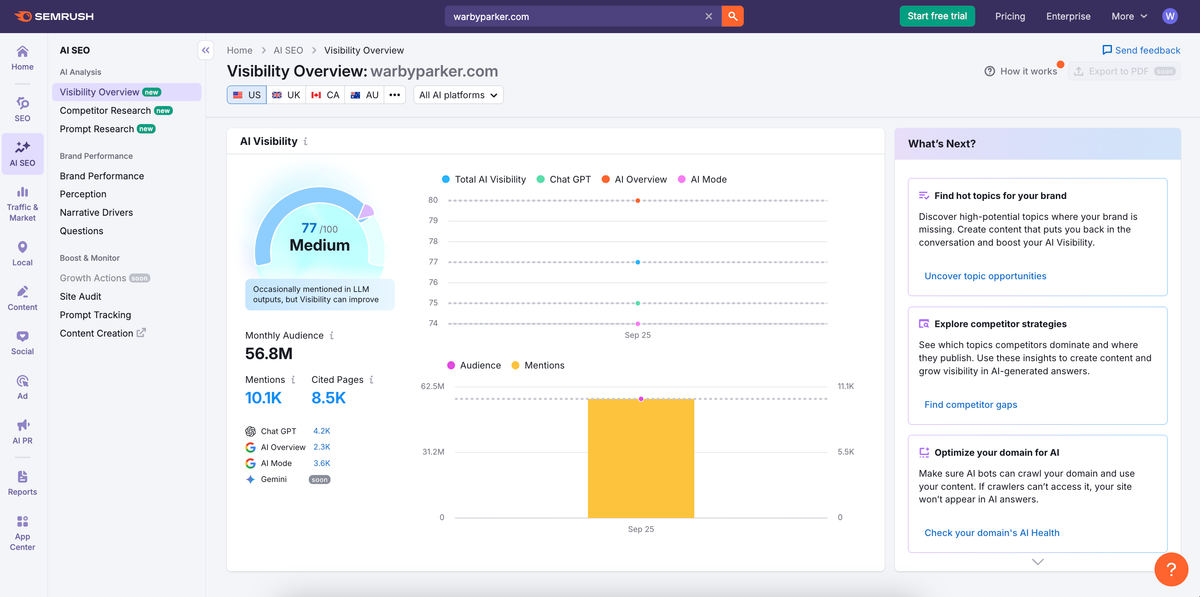
SEMrush - Score: 50/80
Prompt research - SEMrush includes Prompt Research functionality, providing prompt suggestions and related insights. However, both Prompt Research and Prompt Tracking are currently limited to the US market, with rollout to other regions expected imminently.
Score: 4/10
Competitor analysis - SEMrush is the only platform on the list which allows you to perform an analysis of your domain (or a competitor’s) without identifying your prompts first. You enter the domain and the tool will tell you the top prompts the domain is ranking for. It does this by querying its own database of prompt research and returning ranking data for your domain. Importantly you can view data for your own domain and compare vs multiple competitors. This works in a similar way to any competitor analysis features found in traditional SEO tools, where entering a domain or URL reveals performance insight such as top organic keywords.
Most GEO tools, however, work differently. They require you to first identify and track specific prompts, after which competitors are identified based on who else ranks for those prompts. The limitation with this approach is that it depends on tracking the right prompts in the first place, something that remains a challenge across the current tool landscape. SEMrush’s Visibility Overview and Competitor Analysis features could be invaluable for GEO insight, but their usefulness is heavily dependent on the size and accuracy of SEMrush’s prompt database.
In testing, smaller client domains produced no results, whereas larger clients returned highly actionable data that could directly inform GEO strategy. While still in development, this feature has strong potential to position SEMrush as a market leader within the emerging GEO tool category.
Score: 8/10
Prompt tracking - Prompt tracking is available but only for US geographies. More countries are being made available soon.
Score: 5/10
Content analysis - Content analysis can be undertaken through the visibility overview and competitor research functions of the tool - here you can view prompts you already perform for alongside prompt opportunities. You can also undertake analysis at the prompt level, but as previously mentioned this does not extend past the US market.
Score: 8/10
Technical analysis - SEMrush links out to your SEO Site Audit and uses this to cover technical performance. There are some adaptations to the original report such as AI search health which gives you a tech health score out of 100%.
Score: 7/10
Reporting - Currently no way to export via API or into Looker. However the dashboard does have many useful charts built in.
Score: 5/10
Range of LLMs tracked - Currently ChatGPT, AI Overviews and AI Mode only.
Score: 5/10
Affordability - Flat $99 per domain with the ability to track 50 prompts. This is slightly cheaper than other tools, but you don’t have the ability to split those prompts across multiple domains should you want to.
Score: 8/10
OtterlyAI - Score: 60/80
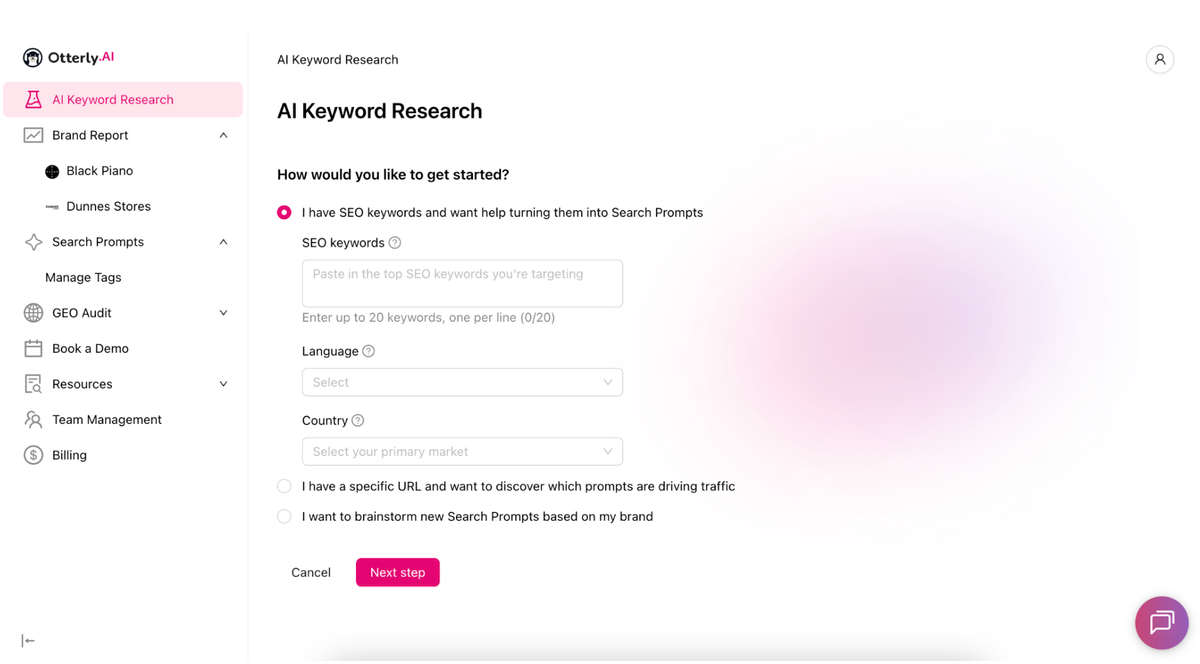
Prompt research - OtterlyAI has an AI keyword research feature which converts your SEO keywords into prompt suggestions, or creates a list of prompts for you based on your brand name or domain. Like all GEO tools currently, it’s difficult to say how accurate prompt suggestions actually are in terms of search volume, but the important thing is that OtterlyAI are prioritising prompt research as a feature within their tool.
Score: 7/10
Competitor analysis - You can view competitor data like brand mentions and citations against the prompts you track only. You cannot view data for prompts you are not tracking - this is standard across most tools other than SEMrush currently.
Score: 7/10
Prompt tracking - The feature works well allowing you to assign tags to prompts to better organise them.
Score: 8/10
Content analysis - OtterlyAI and Peec AI have similar features here. Content analysis is conducted by reviewing top domains and URLs against the prompts you are tracking - you can view this for both mentions and citations. Ideally you would be able to identify top content from competitors without needing to already track the prompt - this is a common challenge across most tools.
Score: 7/10
Technical analysis - While it’s debatable how usable some of this data is (llm.txt analysis for example) this features still allows you to get some understanding of the technical components that will affect GEO. Data is also available at the URL level to allow you to create specific insights.
Score: 7/10
Reporting - OtterlyAI provides dashboard reports and data exports, with API access, MCP access and a Google Looker Studio connector available from the Standard plan. These options allow agencies to combine AI visibility data with other marketing metrics and build client reports outside the platform. Teams choosing the lower-cost Lite plan should account for these reporting features requiring an upgrade. Score: 6/10
Range of LLMs tracked - Tracks across AIO, ChatGPT, Perplexity, Google AI Mode, Gemini and Copilot.
Score: 8/10
Affordability - OtterlyAI has the cheapest entry-level plan at $29/month (15 prompts), Standard plan at $189/month (100 prompts), and Enterprise at $489+/month (400+ prompts)
Score: 9/10
Peec AI - Score: 52/80
Prompt research - Peec AI gives you suggested prompts and prompt volume estimations. Estimated prompt volume is based on two complementary data sources: clickstream panel data from over 50 million global users and Google search volume data. It’s difficult to say how accurate this is (for all tools that use similar methods, not just Peec) but for now but it is certainly one of the better solutions to prompt research on the market.
Score: 7/10
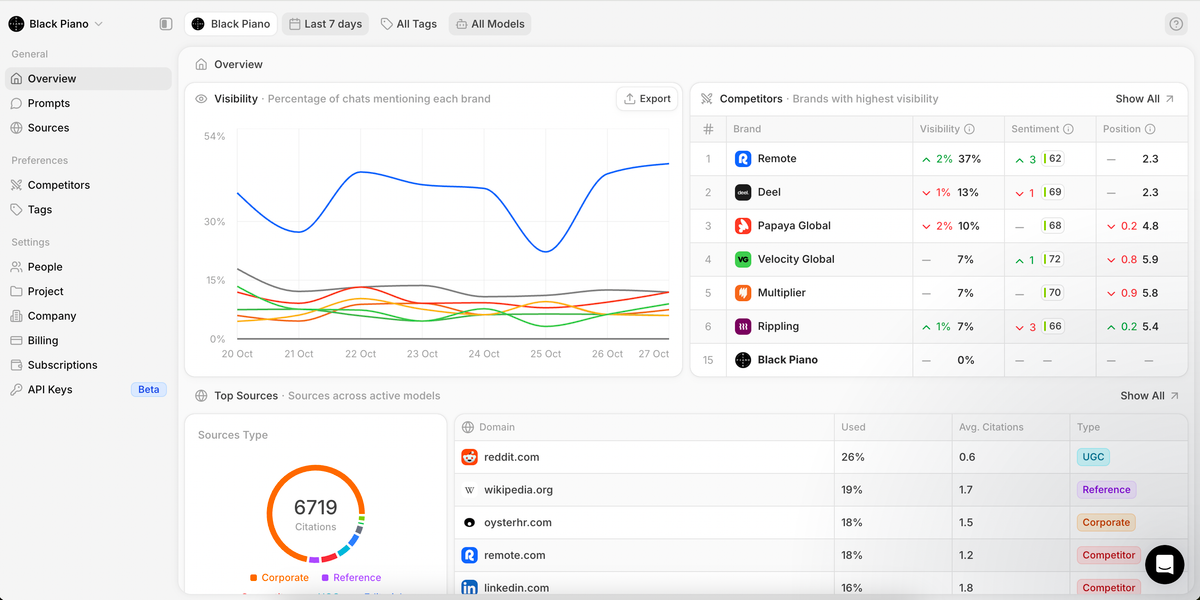
Competitor analysis - You can view top performing competitor data like brand mentions and citations against the prompts you enter and you can also manually add competitors as a comparison. Similar to all GEO tools other than SEMrush, what you see will be based on the prompts you are tracking only, you cannot view top prompts by domain.
Score: 7/10
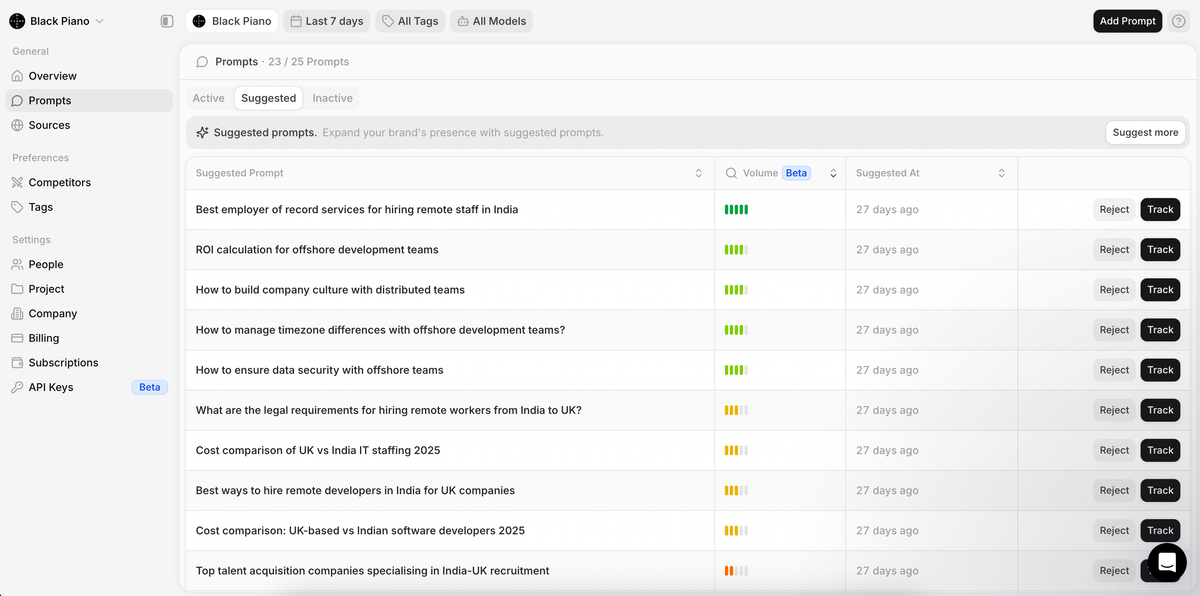
Prompt tracking - The system gives you prompt suggestions alongside est. volumes. You can also assign tags to prompts to better organise them.
Score: 8/10
Content analysis - Content analysis is conducted by reviewing top domains and URLs against the prompts you are tracking - you can view this for both mentions and citations. Ideally you would be able to identify top content from competitors without needing to already track the prompt - this is a common challenge across most tools.
Score: 7/10
Technical analysis - Currently no technical data in-platform. We are told there is a GEO audit feature in the roadmap which will enable you to get a view on technical performance.
Score: 0/10
Reporting - Has Looker Studio and API connector and reporting is clearly a priority in the roadmap, this is critical for agencies who want to be able to model GEO data for client reports. The tool dashboard itself looks great and Peec AI has really clear comparative reporting for Brand visibility (mentions) and Source Domain (citations). Peec AI also has account-level access meaning you can grant client’s access to individual projects easily within the dashboard.
Score: 9/10
Range of LLMs tracked - One downside to Peec AI is you only get - ChatGPT, Perplexity & AIO in the non-enterprise packages. Gemini, AI mode and Claude are available at an extra cost.
Score: 6/10
Affordability - Peec AI has 3 paid plans Starter at €89/month (25 prompts), Pro at €199/month (100 prompts), and Enterprise at €499+/month (300+ prompts)
Score: 8/10
Promptwatch - Score: 56/80
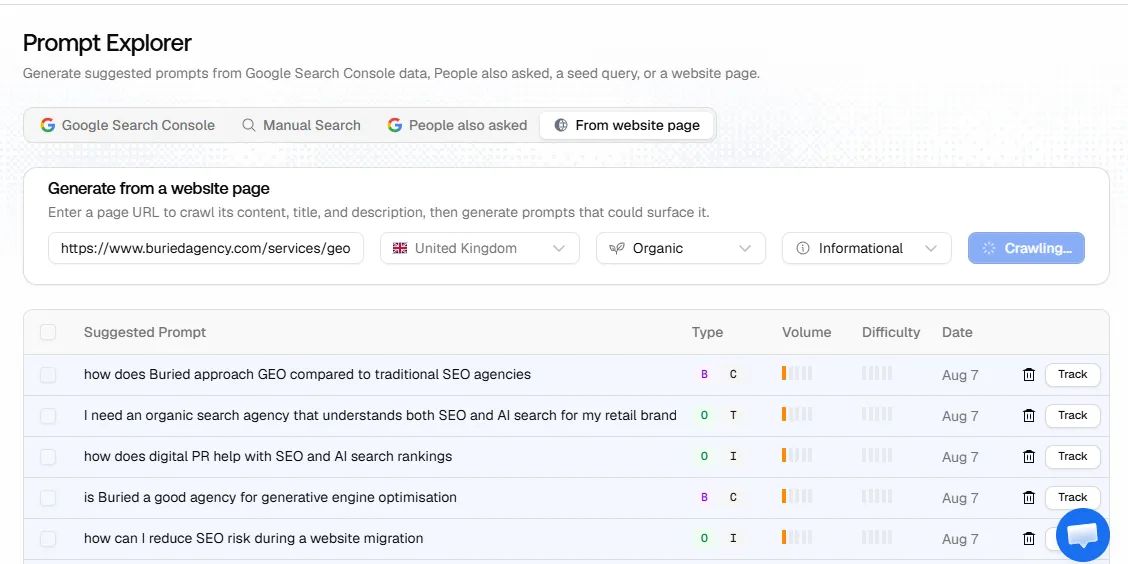
Prompt research - Promptwatch takes a different route into prompt discovery than most tools here: connect Google Search Console, and it generates prompts from queries you already rank for - first-party data rather than a model guessing what your customers ask. You can also pull from keyword data via a DataforSEO connection, generate prompts with AI, or paste in a URL and have it build a prompt set from that page alone. A prompt volume database with difficulty and citation-rate scores sits on top of all four.
Score: 7/10
Competitor analysis - Share of voice and mention share are tracked over time against a defined competitor set, alongside an entity tracker for brands and products that come up in responses. The more useful piece is Offsite Mentions, which grids your brand and competitors against every third-party page AI models are citing in your category, flagging where competitors appear and you don’t.
Score: 7/10
Prompt tracking - Prompt volumes run from 50 on the entry plan up to 350 on the top tier, with daily refresh and country-level tracking included across all plans. State and city-level tracking and sentiment analysis are reserved for Professional and above. Multi-language support currently covers English, Dutch, German, Portuguese and Japanese.
Score: 6/10
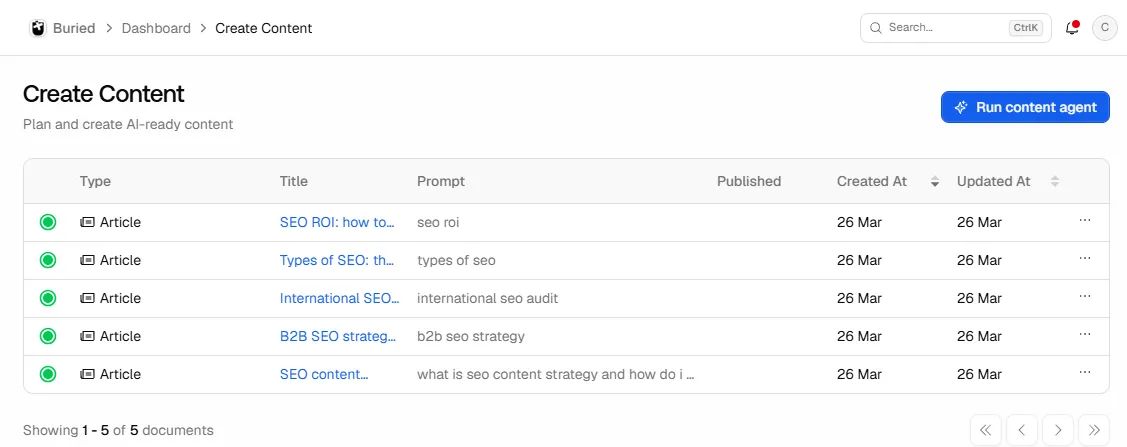
Content analysis - Content gap analysis benchmarks coverage against tracked prompts, but Offsite Mentions does more of the work, ranking third-party pages by how often they’re cited, breaking coverage down by content type (listicle, how-to, comparison), and filtering for pages where competitors show up and you don’t. A Content Agent can also draft, edit and publish directly to a connected CMS based on that gap analysis, though that’s a feature we’d want to see used with a human checking the output before it goes live.
Score: 7/10
Technical analysis - Agent Analytics provides real-time AI crawler logs (ChatGPTBot, ClaudeBot, PerplexityBot) via Cloudflare, Fastly, Vercel or AWS, with crawl-to-citation attribution showing which pages get crawled and cited versus crawled and ignored. It’s a reasonable technical feature set, though it’s gated to Professional and above rather than available on the entry plan.
Score: 6/10
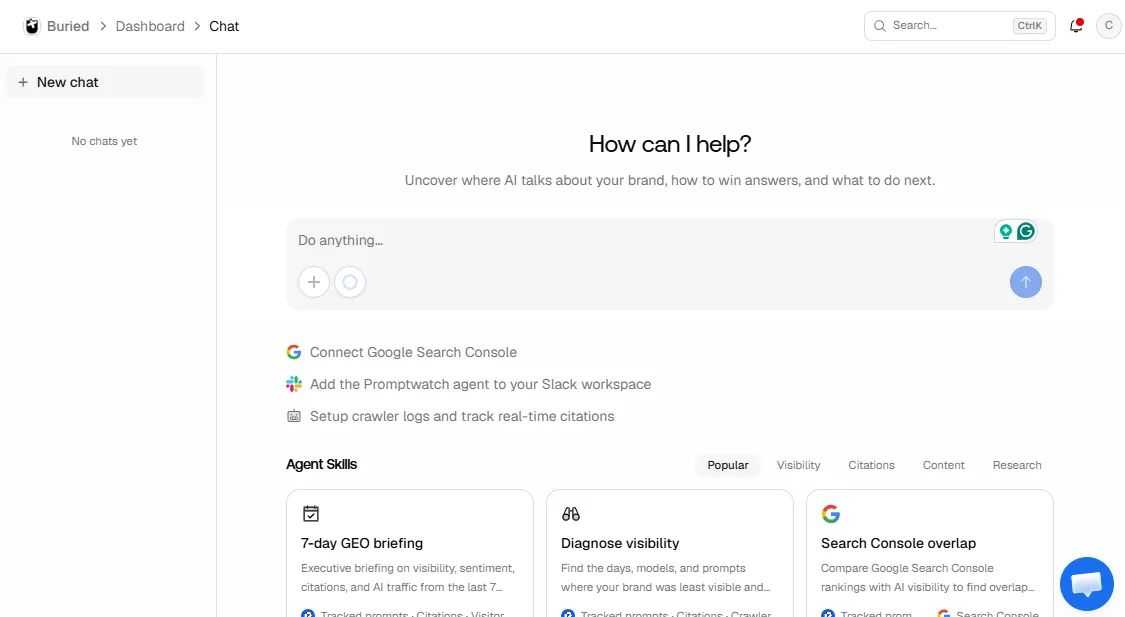
Reporting - API and MCP access is included on every plan, including the $95 entry tier - most tools in this category reserve that for enterprise packages. There’s also a Looker Studio connector, CSV export, and an Agent Chat feature that builds a visibility report for a given date range on request. Agencies get whitelabel dashboards and scheduled email delivery.
Score: 8/10
Range of LLMs tracked - Coverage spans ChatGPT, Google AI Overviews, AI Mode, Gemini, Claude, Perplexity, Grok, DeepSeek and Meta Llama, plus developer surfaces like OpenCode and Claude Code, with all models available on every plan. Data is collected from live model interfaces rather than APIs, the same approach used by other tools in this review.
Score: 8/10
Affordability - Promptwatch starts at $95/month for 50 prompts and includes API access from the entry tier. There’s no free-forever plan, just a 7-day trial, and the Business tier is book-a-demo only.
Score: 7/10
MentionBird - Score: 54/80
Prompt research - MentionBird suggests prompts using your brand, competitors, existing tracked questions and the sources cited in your category. Suggestions focus on recommendation and comparison questions, which gives you a starting point for tracking buying decisions.
Difficulty and search-volume scores help prioritise prompts, although the published documentation does not explain their underlying demand data in enough detail to give them the same weight as validated search volumes.
Score: 6/10
Competitor analysis - You can compare brands through mention rates, share of voice and average positions in ranked answers. The prompt-level leaderboard also includes brands you have not configured as competitors, helping you identify rivals outside your existing comparison set.
The limitation is familiar across this category: your analysis depends on the prompts you track. MentionBird’s documented workflow does not provide the broader domain-level prompt discovery discussed in the SEMrush review.
Score: 7/10
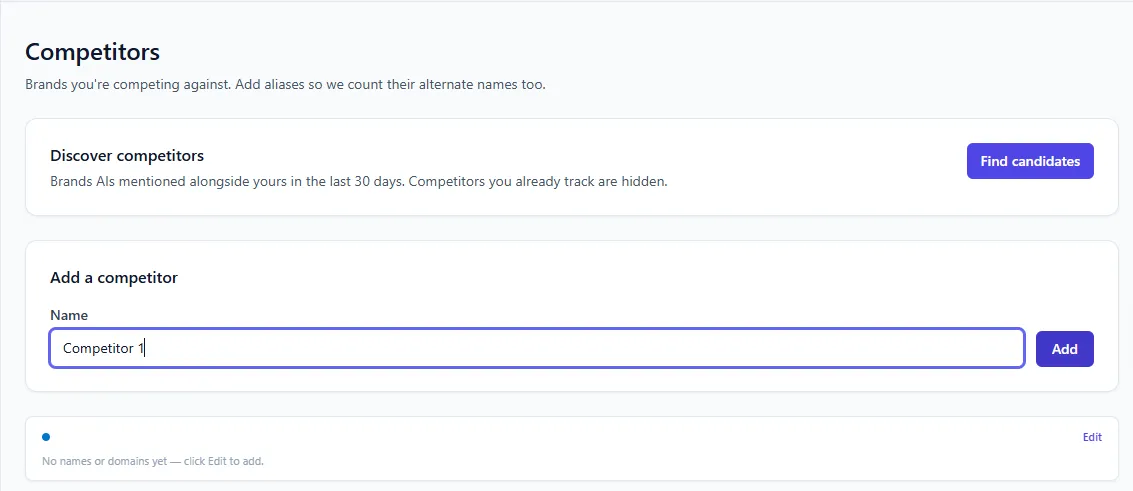
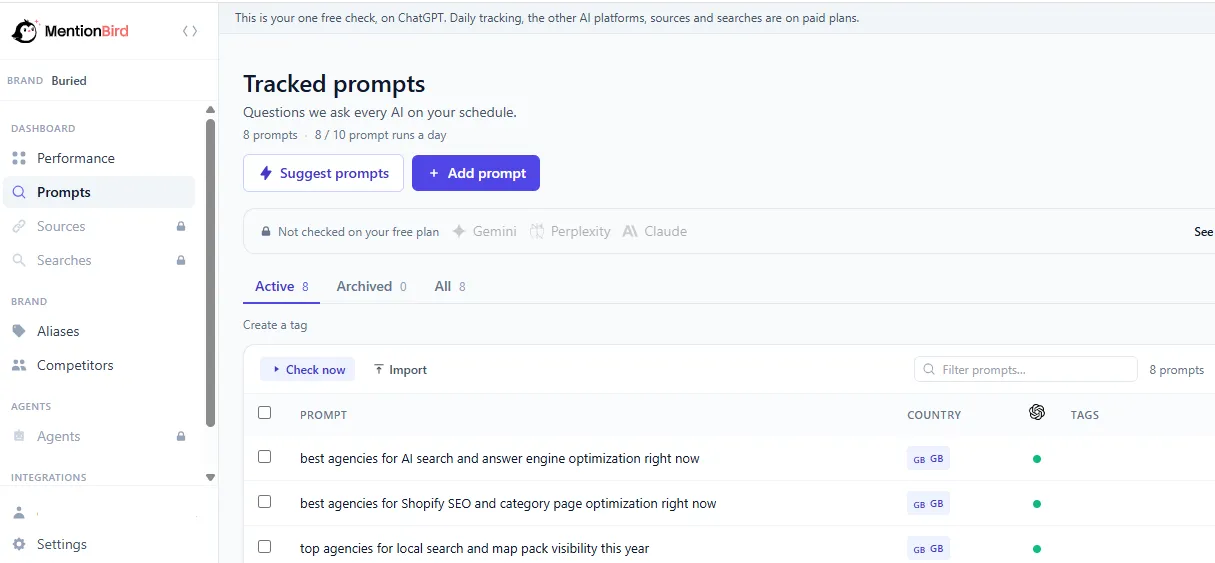
Prompt tracking - MentionBird checks prompts daily, stores historical answers and lets you group questions with tags. You can examine results by platform, monitor sentiment and target countries, giving you several ways to investigate changes beyond an overall visibility score.
Country targeting uses a location signal rather than guaranteeing a regional answer. Capacity also counts each prompt-platform combination separately, so monitoring one question on four platforms consumes four daily runs.
Score: 7/10
Content analysis - You can examine cited domains and individual URLs, with classifications for source type and content format. This helps distinguish opportunities to improve your own pages from opportunities to earn coverage elsewhere.
MentionBird’s AI Ranking Advice takes this further by reviewing citation data, checking your existing content and returning prioritised recommendations with supporting URLs and effort estimates. It also checks whether a suggested outreach target already mentions you.
This connects visibility gaps with specific content and outreach tasks. However, the advice needs sufficient citation data to be useful, and your team must assess the recommendations and carry out the work.
Score: 7/10
Technical analysis - MentionBird offers a free crawler accessibility checker covering robots.txt rules and live page access. Its AI Content Score checks page structure, freshness and schema markup, while ranking advice can suggest fixes for crawler access and structured data.
These checks help identify technical issues worth investigating. The coverage is less comprehensive than a full site audit or ongoing crawler-log analysis, but provides useful direction alongside its visibility and citation reports.
Score: 6/10
Reporting - CSV exports cover cited domains, individual URLs and detailed prompt-page combinations. API and MCP access are included on every paid plan, allowing you to query visibility, competitors, citations and recorded answers outside the dashboard.
This gives teams useful flexibility for analysis and reporting. The published documentation does not establish a native Looker Studio connector or project-level client permissions, leaving some agency reporting requirements less clearly covered than with Peec AI.
Score: 7/10
Range of LLMs tracked - MentionBird supports ChatGPT, Gemini, Perplexity, Claude, Google AI Overviews, Grok, Microsoft Copilot and DeepSeek. Access depends on the subscription: Starter includes ChatGPT and Gemini, Growth adds Perplexity and Claude, and Custom covers all eight.
The overall coverage is broad, but accessing the full range requires a bespoke package. Google AI Mode is not listed among the supported platforms.
Score: 7/10
Affordability - Starter costs $79/month for 100 daily prompt runs, one brand and five configured competitors. Growth costs $299/month for 400 runs, three brands and ten competitors per brand. Custom pricing depends on requirements.
Starter can cover 50 questions across its two included platforms. Ranking advice uses a separate monthly credit allowance, so both tracking capacity and advice usage need to fit your workload. Entry-level API access adds value, although there is no free plan or trial. Score: 7/10
Athena - Score: 59/80
Prompt research - Athena’s Prompt Planner identifies prompts through multiple approaches, including keyword analysis, target persona creation, location targeting, and insights drawn from eight different LLMs. It provides prompt volume estimates by combining traditional search data with anonymised clickstream data from LLM search activity. While the tool offers a wide range of methods for prompt discovery, Prompt Planner is only available to enterprise-tier users.
Score: 8/10
Competitor analysis - Competitors are automatically generated by the system based on your selected prompt set and the brands performing against it. Content recommendations are derived from a gap analysis between your prompts and those competitor sets. Athena offers page and URL-level analysis based off the prompt responses you run.
They also plan to release a large searchable database soon allowing you to view data at the domain level, not just based on pre-defined prompts. Athena also offers Agencies the ability to plug in a Brand/Url and it will return an AI Audit with competitor analysis for pitches. Score: 8/10
Prompt tracking - One of the biggest challenges in GEO right now is knowing which prompts to track. With no reliable way to estimate prompt volumes and an almost unlimited number of possible variations, it can get complicated fast. Athena tackles this with its Prompt Fan-Out feature, one of the few tools to offer a real solution.
Prompt Fan-Out creates up to four variations of each prompt, swapping in synonyms, reordering words, or adding question marks to make sure the topic is fully covered. Athena then continues to test and rotate through additional variants automatically to capture a complete picture of how that prompt performs.
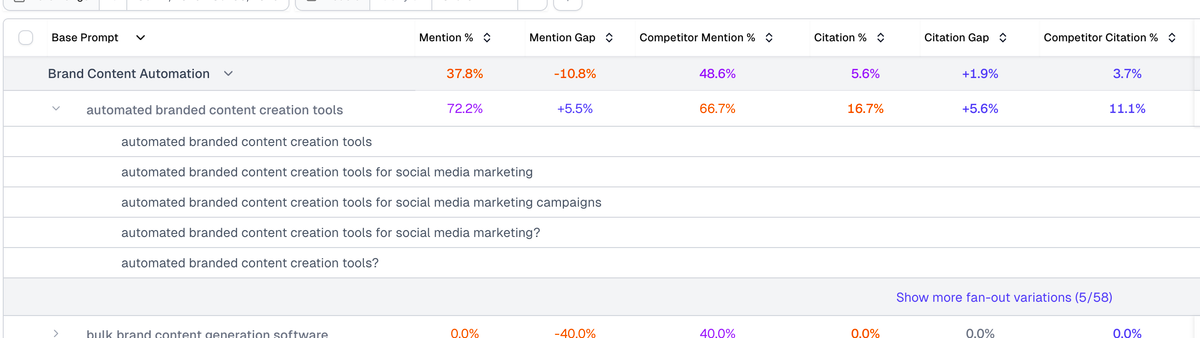
Prompt tracking includes standard tools like tagging, but Athena also lets you set your own scraping rules, for example, collecting data two or three times a week instead of daily. This helps cut down on bandwidth use and keeps package costs lower.
Score: 9/10
Content analysis - Athena is very content-focused, taking gap analysis, planning, and content creation a step further than most other tools. It offers four main features: writing content for AI search, optimising existing content for AI search, “sniping” highly cited content, and splitting content into multiple articles ready for AI search. The platform runs content gap analysis to guide ideas and structure, highlighting topic clusters where your website is weakest and helping you prioritise which areas to tackle first. It can also generate content to help fill those gaps.
One interesting aspect is Athena’s Action Centre, which prioritises tasks for you. The exact workings are proprietary, but the algorithm reportedly takes into account prompt volume, opportunity, and competition data.
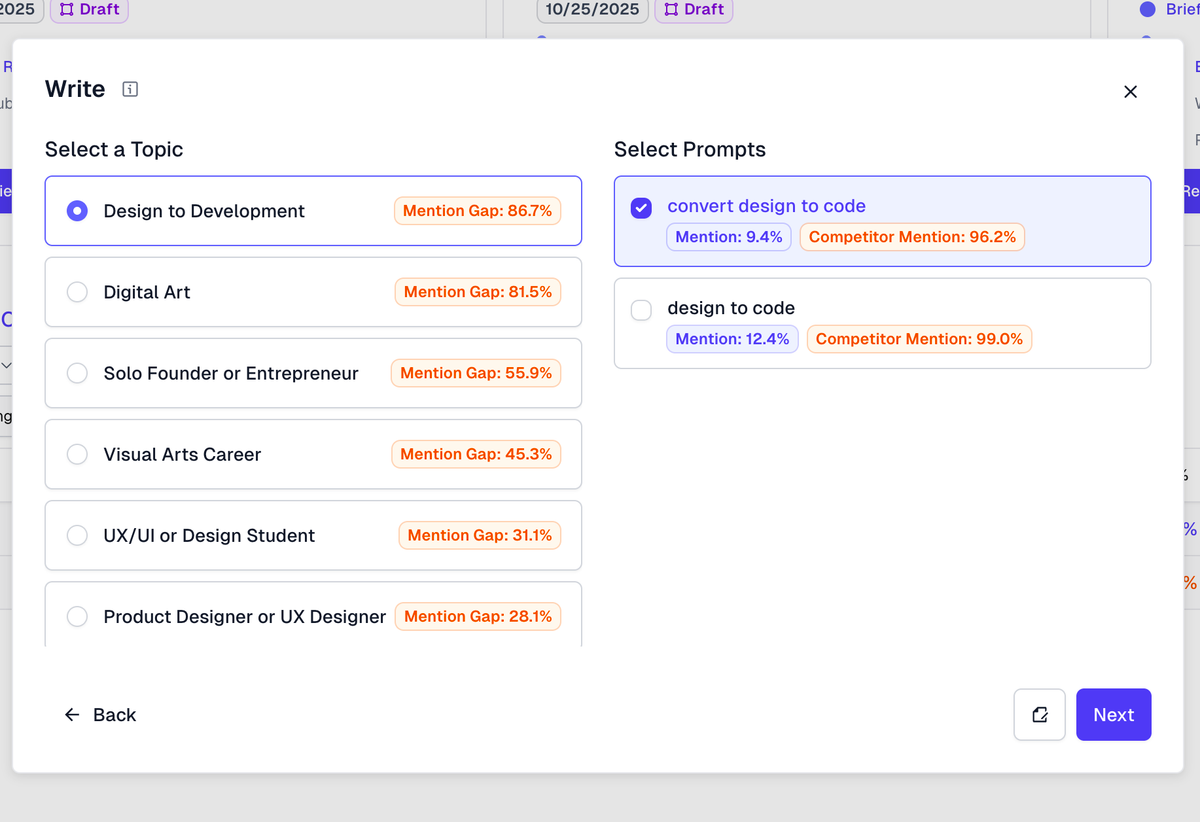
Athena also includes an analyst chatbot called Ask Athena. This can perform tasks such as analysing patterns in your dashboard data, for example, answering questions like, “Why is my competitor’s share of voice increasing?”
Score: 9/10
Technical analysis - Athena currently offers some features around technical performance. Within the Outreach tool, which helps you identify and plan outreach opportunities, the platform will indicate whether a source page is crawlable by LLMs. Within this tool you can also check crawlability for any URLs you enter Athena also provides a pitch workspace for agencies and can generate content audits to support client engagement. This would be an ideal place to include some high-level technical performance insights, an area where most GEO tools are still lacking.
Score: 3/10
Reporting - Athena offers a comprehensive dashboard with multiple ways to filter data, including brand and non-brand prompts. A Looker API is currently in beta and expected to be released soon. Project-level access is also available, allowing you to grant specific permissions to clients or team members.
Score: 9/10
Range of LLMs tracked - Tracking across 8 LLMs including ChatGPT, Gemini, Perplexity, AI Overview, Claude, Grok, Copilot, AI Mode soon to come.
Score: 9/10
Affordability - Athena starts at $295 per month for 3500 credits, 1 credit = 1 prompt tracked across 1 LLM. Monthly billing is available for brands, but not for agencies, making the barrier to entry higher than other providers.
Score: 4/10
Profound - Score: 58/80
Prompt research - With Profound you define a topic and the platform surfaces the highest-volume, most relevant prompts or you can manually create each prompt. Profound’s data is grounded in real-user conversation-query behaviour. It boasts the largest dataset of real user prompts on the market, with prompt-volume estimates based on phrase-matching of your topic name and derived from real user panels. Profound prompt research tool breaks down volume by intent (information, comparison, purchase, etc), so you can see not just how many people ask something, but why they’re asking it.
Prompt data is updated on a rolling basis (with latency typically under one week) so you’re working off near real-time trend. As accurate prompt research remains one of the biggest challenges in the field, Profound’s focus on real-user data to guide and validate the process represents a major advantage.
Score: 9/10
Competitor analysis - Profound automatically identifies your top competitors based on the prompts you track, showing which brands or creators are gaining the most visibility through mentions, citations, and content performance. You can manually select competitors or let the tool recommend them, with up to five suggestions available on non-enterprise plans.
Performance can also be compared across specific personas or demographics, helping you understand how your insights resonate with different audience groups and where your prompt strategy has the strongest impact.
Score: 8/10
Prompt tracking - Profound takes prompt tracking a step further by not only monitoring the performance of your prompts but also revealing how Answer Engines interpret them. Through its Query Fanout feature, the platform shows the actual high-intent search queries that AI models like ChatGPT, Claude, or Gemini generate to answer a given prompt. This makes it possible to see the expanded set of queries, including modifiers like “best,” “top,” or “reviews”, that drive information retrieval, ensuring your content aligns with how AI actually researches and ranks answers. By combining near real-time prompt tracking with these query fanouts, Profound helps you optimise content for both visibility and relevance in AI-mediated search, providing insights that go beyond the original prompts themselves.
Something unique to Profound at this stage is prompt tracking for shopping - this lets you see exactly how your products appear in ChatGPT Shopping and other AI-powered shopping surfaces. The platform tracks the prompts and keywords that trigger your product listings, monitors placement trends, and analyzes competitor visibility and retailer coverage. With AI occupying further into the funnel, allowing people to check out direct from the interface, monitoring of these listings will become critical. Profound are ahead in this sense.
Score: 9/10
Content analysis - Profound’s content analysis lets you see which prompts your content, while also showing the top-performing competitor content for each prompt so you can benchmark effectively. Insights are provided at the topic level, with the option to filter by tags for more granular analysis.
Similar to Athena, Profound helps you take the next step in your content optimisation. The Actions tab helps you create new content or optimise existing content, prioritised based on opportunity. Profound are also developing automated workflows that should make this process more efficient.
Score: 8/10
Technical analysis - Limited technical features currently but we are told an AEO site audit feature will be rolled out very soon which will include technical components.
Score: 2/10
Reporting - We mentioned workflows earlier, this automation can also extend to reporting. For example, you can have Slack notify you if sentiment drops or monitor citation levels and get alerts when a page falls above or below a set threshold. Profound also offers Looker and API access, letting you export and model your data outside the dashboard for deeper analysis. With user-level access, you can grant specific teams, personnel, or clients tailored permissions to view or manage particular projects within the dashboard.
Score: 9/10
Range of LLMs tracked - 10 LLMs tracked on the Enterprise plan, 3 in the Growth plan and ChatGPT only in the Starter plan.
Score: 9/10
Affordability - Profound starts at $99 per month tracking 50 prompts but is ChatGPT only, Growth plan is $399 per month for three answer engines, Enterprise packages are tailored based on requirements. Both Profound and Athena require you to have an enterprise packages to access much of the functionality.
Score: 4/10
Final Result: What is the best GEO tool?
The tools included in this review have been selected as they are trailblazers in the GEO tool market. Each tool has its own strengths and weaknesses but all have only made it into this review because we consider them best in class. Which tool you select should be based on your business and your circumstances:
Table of comparison
| Criteria | SEMrush | OtterlyAI | Peec | Athena HQ | Profound | Promptwatch | MentionBird |
|---|---|---|---|---|---|---|---|
| Prompt research | 4 | 7 | 7 | 8 | 9 | 7 | 6 |
| Competitor analysis | 8 | 7 | 7 | 8 | 8 | 7 | 7 |
| Prompt tracking | 5 | 8 | 8 | 9 | 9 | 6 | 7 |
| Content analysis | 8 | 7 | 7 | 9 | 8 | 7 | 7 |
| Technical analysis | 7 | 7 | 0 | 3 | 2 | 6 | 6 |
| Reporting | 5 | 6 | 9 | 9 | 9 | 8 | 7 |
| LLMs tracked | 5 | 8 | 6 | 9 | 9 | 8 | 7 |
| Affordability | 8 | 9 | 8 | 4 | 4 | 7 | 7 |
| Total | 50 | 59 | 52 | 59 | 58 | 56 | 54 |
Best GEO tool for getting started - OtterlyAI
OtterlyAI scored joint highest in this review as it performed well across all areas of the scoring system. It is an excellent all-round tool and the most accessible due to having the lowest cost starter plan of any tool. OtterlyAI has a broad feature set and more technical GEO consideration than most other tools, this is an area neglected by most tools currently. OtterlyAI gives brands the opportunity to get into GEO data and start understanding AI search impact with minimal commitment.
Best GEO tool for agencies - Peec AI
Peec AI provides exceptional reporting functionality at an accessible cost. It performs well in many areas within this review but has standout reporting options through Looker Studio, Peec AI API and the dashboard itself. The tool also allows you to grant project level access to clients, allowing them to have direct access to the tool. This focus on reporting flexibility helps agencies to provide clarity to clients around AI search and GEO impact, which is the most critical thing as the organic search landscape evolves.
Best GEO tool for enterprise - Athena & Profound
This is a two-horse race and it’s really hard to pick one tool as the clear standout winner for enterprise. Both Athena and Profound have features that improve prompt tracking coverage and accuracy through Prompt Fan-Out, helping solve the industry-wide challenge of tracking prompts reliably. These tools take content analysis a step further, letting you plan and create content prioritised based on opportunity. This, along with the flexibility and detail across every part of the dashboards, is what justifies the extra cost. Once you start using the tools, it’s easy to see why they’re aimed at the top end of the market.
To get the most out of them, you need an enterprise plan, which generally starts around $1,000 per month and will be a barrier for most brands. For enterprise teams with large content operations, a flexible strategy, and a clear focus on GEO, Athena and Profound are the market leaders.
Best GEO tools for citation opportunities - Promptwatch & MentionBird
Promptwatch and MentionBird help teams identify cited pages where competitors appear and their own brand is missing. Promptwatch’s Offsite Mentions feature supports this research across third-party sources. MentionBird adds prompt-specific advice on improving existing pages and pursuing relevant coverage. Both suit teams planning content and outreach from citation data, although the right choice depends on platform coverage, reporting needs and budget.
Honourable mention: SEMrush
SEMrush’s GEO toolset shows high potential as it is currently the only tool that allows visibility and competitor analysis at the domain level, rather than being limited to a pre-defined list of prompts. Domain-level analysis is a core part of traditional SEO, and if SEMrush can replicate this for LLMs, it could see widespread adoption and gain a major competitive advantage. That said, much of the rest of their toolset still lags behind the market. For example, prompt tracking outside the US is not yet covered.
Closing thoughts
The best GEO, AEO, or AI SEO tracking solution for your brand will depend on several factors, including the breadth of prompts you want to track, the flexibility of your content strategy, and your wider organic search approach.
Our advice is simple: just get started. And that’s exactly what we can help you do. Get in touch today to begin exploring your AI search visibility.
Work with Buried
Speak to an AI search expert
Not sure which GEO tool fits your stack? We have tested them all. Tell us your goals and we will help you start measuring AI search visibility.
Book a call
About the author
Will Tombs
Founder, Buried
Will Tombs is the Founder of Buried. He’s an award-winning growth marketing specialist and expert in SEO and GEO. With over 12 years’ experience in industry, Will has led digital strategy for: Startups that have gone on to be acquired, international enterprise retailers, and his own e-commerce businesses.
From the blog
Related Posts
GEO vs AEO vs AI SEO
What the different names mean, and why they describe one discipline.
Will TombsRead →Top 5 AI search KPIs marketers must track
The metrics that show whether your GEO work is landing.
Will TombsRead →5 steps to amplify your LLM brand entity visibility
A data-driven GEO playbook for getting cited by AI.
Will TombsRead →