The search landscape is changing rapidly. AI-driven platforms like ChatGPT, Perplexity, Claude, and Google AI Mode are now answering questions directly, not just listing links.
This shift has altered how brands are discovered online. Ranking on a results page is no longer the only goal. Being referenced by AI is. This new reality has given rise to Generative Engine Optimisation (GEO). GEO focuses on making your brand visible, credible, and usable within AI-generated answers.
At the heart of this sits Digital PR. Digital PR is a critical pillar of GEO because it builds the authority and trust that Large Language Models rely on when deciding what to cite.
Understanding GEO: The new frontier of search
Generative Engine Optimisation (GEO) is the process of optimising a brand and its content so it can be discovered, understood, and recommended by AI-driven search engines. These include platforms like ChatGPT, Perplexity, Claude, Google AI Mode, and Google’s AI Overviews.
Instead of ranking pages, GEO helps brands appear inside AI-generated answers. The shift from traditional SEO to GEO is significant. As explained in the Buried guide, GEO vs SEO: what’s the difference, SEO is built around ranking URLs for specific keywords. GEO, on the other hand, is about ensuring your brand, insights, or data are cited, referenced, or recommended directly within an AI response.
Most GEO frameworks are built on three core pillars:
- Content – Clear, expert-led, well-structured information
- Technical – Accessibility, structure, and machine readability
- Authority – Credibility, reputation, and third-party validation
This article focuses on the authority pillar, where digital PR plays a defining role.
Why authority is the cornerstone of GEO
Large Language Models are built to pull information from many sources and combine it into one clear answer. Their priority is accuracy. To reduce the risk of misinformation, they favour sources they already recognise as credible, consistent, and widely trusted.
In the context of GEO, authority is not a single signal. It is a combination of:
- Trusted citations across the web
- Consistent brand mentions in reputable publications
- Positive and neutral sentiment linked to your brand and expertise
AI systems look for patterns. Brands that appear repeatedly in reliable contexts are more likely to be referenced or recommended in AI-generated answers. Those that do not are ignored, even if their website is well optimised.
In a study of 75,000 brands, those in the top 25% for web mentions averaged about 169 AI Overview mentions - over 10× more than the next quartile (about 14 mentions). Lower-mentioned brands averaged only 0-3 mentions, effectively disappearing from AI summaries.
This is where digital PR becomes essential. Unlike on-site tactics, digital PR actively builds off-site authority. It places your brand in trusted environments, strengthens credibility at scale, and sends the signals AI engines rely on when deciding who to include in their answers.
How digital PR directly fuels GEO performance
Digital PR plays a far broader role than traditional link building. In the context of GEO, it helps shape how a brand is talked about across the web.
This matters because AI search engines rely on a mix of trained knowledge (pre-learned information from trusted sources) and live web information to generate answers. What they see repeated, cited, and trusted influences what they recommend.
Digital PR for GEO is not about chasing volume. It is about being present in the right contexts, with the right message, on sources AI already trusts. This is the approach taken by a specialist digital PR agency that understands how authority feeds AI visibility.
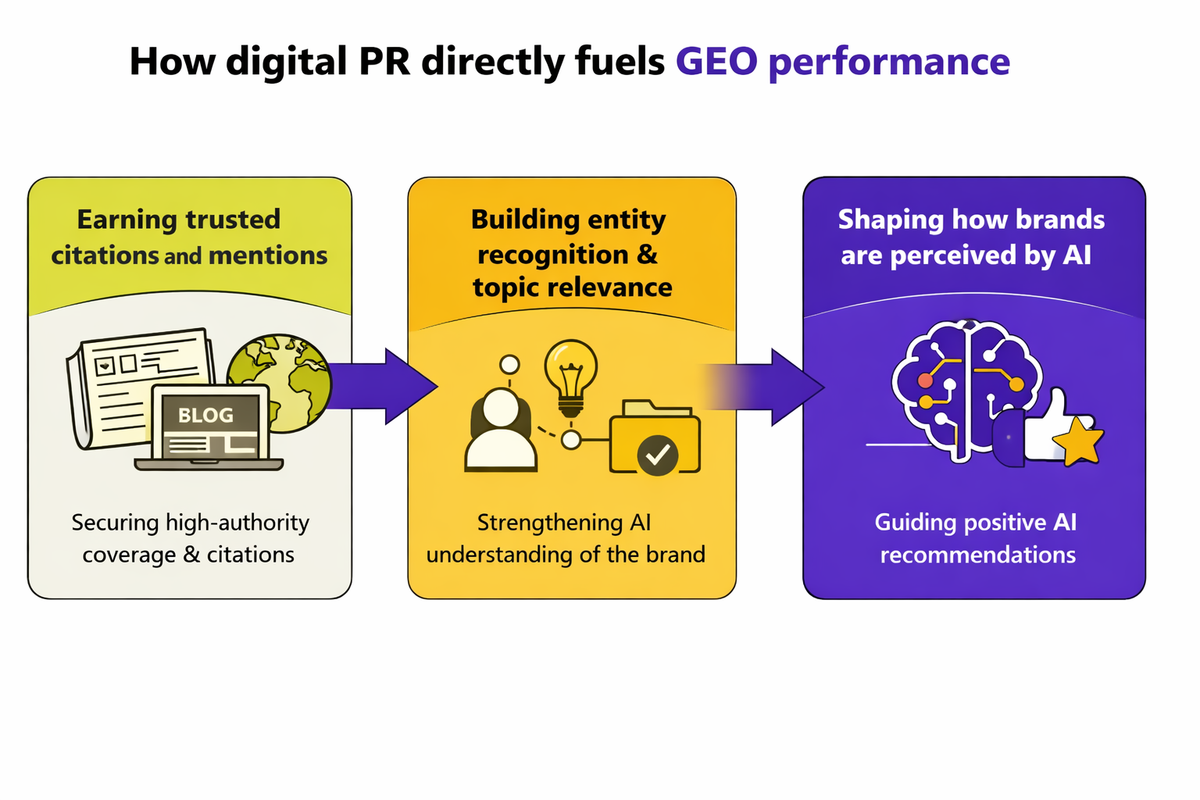
Earning trusted citations and mentions
Effective Digital PR campaigns secure coverage in high-authority publications. These include national news websites, respected industry journals, and well-established blogs with strong editorial standards. These are the sources AI engines regularly reference when validating information.
Each citation or brand mention acts as a signal of credibility. When a brand is consistently referenced in trusted environments, it becomes easier for AI systems to verify its expertise. Over time, these signals stack up. The brand moves from being unknown to being a reliable source. In GEO, this shift is critical.
Building entity recognition and semantic association
In GEO, an entity is a clearly defined subject such as a person, brand, product, or organisation. AI systems use entities to understand who is being discussed and what they are known for.
Consistent digital PR coverage helps reinforce this understanding. When a brand is repeatedly mentioned alongside specific topics, AI begins to link the entity with that area of expertise. For example, if a brand is consistently referenced in articles about cybersecurity solutions, AI engines learn to associate that brand with cybersecurity knowledge and authority.
Shaping the narrative for favourable recommendations
Digital PR gives brands the ability to shape how they are perceived, not just by people, but by AI systems as well. Instead of leaving perception to chance, brands can proactively influence the stories being told about them online.
By promoting data-led insights, expert commentary, and credible case studies, digital PR ensures that positive, accurate information is widely available. This is the information LLMs are most likely to absorb and reuse. The aim is not simply to appear in AI answers, but to be positioned as a trusted and recommended option when users ask relevant questions.
Digital PR for GEO vs. SEO: An evolving strategy
Digital PR has always supported search visibility. What has changed is what success looks like. In traditional SEO, Digital PR was largely measured by links and rankings. In GEO, it is measured by mentions, citations, and influence within AI-generated answers.
The difference reflects how search itself has evolved. SEO is still about helping pages rank. GEO is about helping brands become trusted sources that AI engines choose to reference.
In SEO: A focus on backlinks and domain authority
In a traditional SEO model, digital PR is used to earn high-quality backlinks* from authoritative websites. These links pass value to a brand’s website, often referred to as link equity. The stronger the linking site, the greater the impact on rankings.
Success is typically measured by:
- Number of links earned
- Domain authority* of linking sites
- Improvements in keyword rankings
The end goal is clear. Higher rankings lead to more clicks.
*Backlinks - Links from other websites pointing to your site.
*Domain authority - A score estimating a website’s ability to rank in search results.
In GEO: A focus on citations, context, and mentions
In GEO, links still matter, but they are no longer the main signal. Context is critical. AI systems read and interpret the full content of an article, not just the anchor text* of a link.
This means:
- Unlinked brand mentions still carry value
- How and why a brand is mentioned matters
- Repetition across trusted sources builds credibility
The volume and quality of mentions help strengthen entity authority*, which increases the likelihood of being cited or recommended in AI-generated answers.
The end goal - Higher trust leads to more AI citations and recommendations.
*Anchor text - Clickable text in a link that describes the linked page.
*Entity authority - How strongly AI recognises a brand as an expert in a topic.
While links are no longer the only goal, working with a specialist link-building agency supports GEO by strengthening authority through trusted, editorial coverage.
Actionable digital PR tactics for a GEO-first world
An effective GEO strategy brings multiple disciplines together. Digital PR plays a central role by building the authority signals AI engines rely on. When delivered as part of an integrated approach, such as those used by a specialist GEO agency, these tactics directly support AI search visibility.
Below are key digital PR tactics that consistently perform well in a GEO-first landscape.
Data-driven storytelling
Create original research, surveys, or proprietary data analysis that offers genuine insight. Journalists and industry publishers are far more likely to reference unique data than opinions alone. When your brand becomes the primary source of a story, citations follow naturally. These citations act as strong authority signals, helping AI engines recognise your brand as a reliable source of information.
Expert positioning and thought leadership
Position company leaders as trusted experts within their field. This can include commentary on industry trends, regulatory changes, or emerging risks. Each expert quote generates high-quality brand and personal name mentions in relevant content. Over time, these repeated associations reinforce expertise and credibility in the eyes of AI systems.
Targeting “best of” and comparison articles
Listicles and comparison guides, such as “Best X Software in 2026”, play an outsized role in GEO. These articles help AI engines understand product categories, use cases, and leading providers.
Analysis of billions of citations across AI platforms shows that listicle and comparative content formats account for over 25% of all AI citations, making them one of the most referenced types of content that feed into LLM-generated answers.
Being consistently included in these pieces increases the likelihood of favourable AI recommendations. LLMs (Large Language Models) frequently reference such content when generating answers, making this one of the most powerful digital PR tactics for GEO.
Related read: How ChatGPT and other LLMs work?
Conclusion: Integrate digital PR for future-proof growth
Digital PR is no longer an optional add-on. It is now a core part of any modern organic search strategy. As AI search engines decide what to cite and recommend, brands must prove real-world authority, not just technical optimisation. Digital PR is the primary way to build that trust at scale.
The brands that win in GEO are those that combine strong SEO foundations with consistent authority signals across the web. This integrated approach ensures visibility today and resilience tomorrow.
If you are ready to turn AI visibility into customer conversions, explore the specialist organic search services we offer at Buried. To get started with AI search success, contact us today!
Work with Buried
Speak to an AI search expert
Want AI search engines to cite and recommend your brand? Tell us your goals and we will build the digital PR and GEO strategy to get you there.
Book a call
About the author
Will Tombs
Founder, Buried
Will Tombs is the Founder of Buried. He’s an award-winning growth marketing specialist and expert in SEO and GEO. With over 12 years’ experience in industry, Will has led digital strategy for: Startups that have gone on to be acquired, international enterprise retailers, and his own e-commerce businesses.