Search has changed. People no longer rely only on Google. They now ask AI platforms like ChatGPT, Gemini, Perplexity, and Claude for direct answers, recommendations, and comparisons.
GEO is the optimisation of your brand and website for AI search. This guide provides a step-by-step GEO audit framework. This is the first step in understanding AI search visibility and optimising your website to appear in answers on Chat GPT, Gemini, Perplexity, and other LLMs.
What is a GEO audit?
A GEO audit is a thorough analysis of how your brand appears in AI-generated answers.
Instead of asking, “Do we rank on Google?” a GEO audit asks: “Do AI tools talk about us, trust us, and recommend us?” and, “if not, why?”
When someone asks ChatGPT or another AI tool for advice, comparisons, or suppliers, the model decides which brands to mention. A GEO audit checks whether your business is part of that decision.
How a GEO audit differs from an SEO audit
Both SEO & GEO audits focus on:
- Content
- Technical
- Authority
But a GEO audit focuses on different KPIs: Brand mentions and website content citations rather than keyword rankings.
For a full breakdown of GEO vs SEO, read our in-depth article on the Buried website.
What metrics should be checked in a GEO audit?
A GEO audit is not just about “are we showing up in AI?”
It’s about how often you appear, where you appear, and whether it actually drives traffic and conversions.
Below are the key metrics to track.
The 5 main GEO metrics
| Metric | What it means | Why it matters |
|---|---|---|
| Brand mention visibility | How often your brand is mentioned in AI answers, compared to competitors. | If your brand isn't showing up, you're invisible to potential customers. |
| Citation visibility | How often your website or content is used as a source in AI answers. | Shows whether AI trusts your content enough to reference it. |
| Share of Voice (SoV) in AI answers | How often your brand appears vs competitors. | Helps you understand if you're leading or losing visibility in your market. |
| Sentiment & accuracy | Whether your brand is described positively, and if the information is correct. | Visibility is not enough - it needs to be accurate and build trust. |
| Downstream impact (traffic & conversions) | What happens after visibility - visits, leads, and sales from AI platforms. | This is what drives real business value and ROI. |
Additional metrics
Content “extractability” (Can AI use your content easily?)
AI tools don’t read like humans. They scan and extract.
- Answer extractability: Is your content clear enough to be quoted?
- Direct answer presence: Do you answer key questions quickly (in the first few lines)?
- Content structure clarity: Are you using headings, bullet points, and short sections?
- Citation readiness: Do you include stats, definitions, and clear facts?
Simple rule: If it’s easy to read, it’s easy for AI to use.
Entity & authority signals (Do you look credible?)
AI needs to trust you before recommending you.
- Entity clarity: Does AI clearly understand who you are and what you do?
- Brand mention frequency: Are you talked about on other websites?
- Expert signals: Do you show real expertise (author names, experience, insights)?
Think: Would AI see you as a reliable source?
Technical accessibility (Can AI access your site?)
If AI bots can’t read your site, nothing else matters.
- AI crawler accessibility: Can bots like GPTBot access your site?
- Structured data (schema): Extra code that explains your content (e.g. FAQ, organisation info).
- Crawlable content: Is your content visible in plain HTML (not hidden in scripts)?
- Site speed & mobile usability: Fast, accessible pages perform better.
Simple: If AI can’t access it, it can’t recommend it.
Reputation & off-site signals (What others say about you)
AI doesn’t just trust your website. It looks at the wider web.
- Third-party mentions: Are you listed in blogs, comparisons, or directories?
- Community discussions: Are people talking about you on Reddit, Quora, forums?
- Review sentiment: Are reviews positive or negative?
- Digital PR coverage: Have you been featured in trusted publications?
What this means: AI builds trust based on external validation.
Performance & ROI (Does this drive results?)
This is what founders and CEOs actually care about.
- AI referral traffic: Visitors coming from AI tools.
- Branded search growth: More people Googling your brand after seeing it in AI.
- Leads & enquiries: Conversions influenced by AI visibility.
- AI search ROI: Revenue generated vs effort spent.
Bottom line: Is AI visibility turning into real business?
Buried’s GEO audit framework (Step-by-step)
A GEO audit is not something you run in isolation.
AI tools like ChatGPT and Google AI Overviews rely heavily on live web search.
If you’re not visible in Google, you won’t be visible in AI either.
Simple rule: To rank in AI, you also need to rank in Google.
Here’s how Buried Founder, Will Tombs, defines an effective GEO audit:
SEO and GEO should never be treated separately - they are two sides of the same coin. If you’re not ranking in Google, you can’t maximise your visibility in AI search. At the same time, the way AI works is evolving weekly, so staying static simply isn’t an option. Most importantly, visibility means nothing without results. You need to track everything through to traffic and conversions - that’s where the real value lies.
 Will TombsFounder, Buried
Step 1 - Prompt research
This is where everything starts.
In traditional SEO, we focus on keywords. In GEO, we focus on prompts - the actual questions people ask AI tools.
The challenge? There is no reliable data showing what people ask AI. And prompts are long, conversational, and almost infinite in variation.
So, what do we do instead? We build a structured list of prompts based on real user intent. We identify the questions your customers are asking AI tools, such as:
- “Best [service] providers”
- “Top [category] companies”
- “Alternatives to [competitor]”
- “How do I choose a [service]?”
- “Is [brand] worth it?”
These are called prompts (the questions people type into AI).
Where do these prompts come from? Instead of relying on search volume (like SEO), we combine:
- Existing keyword data
- Google Search Console (questions starting with what, how, why)
- Google autocomplete
- Customer questions (sales, support, demos)
Read more - How to do prompt research: The 4-step guide
How we approached prompt research for Tempo Audits
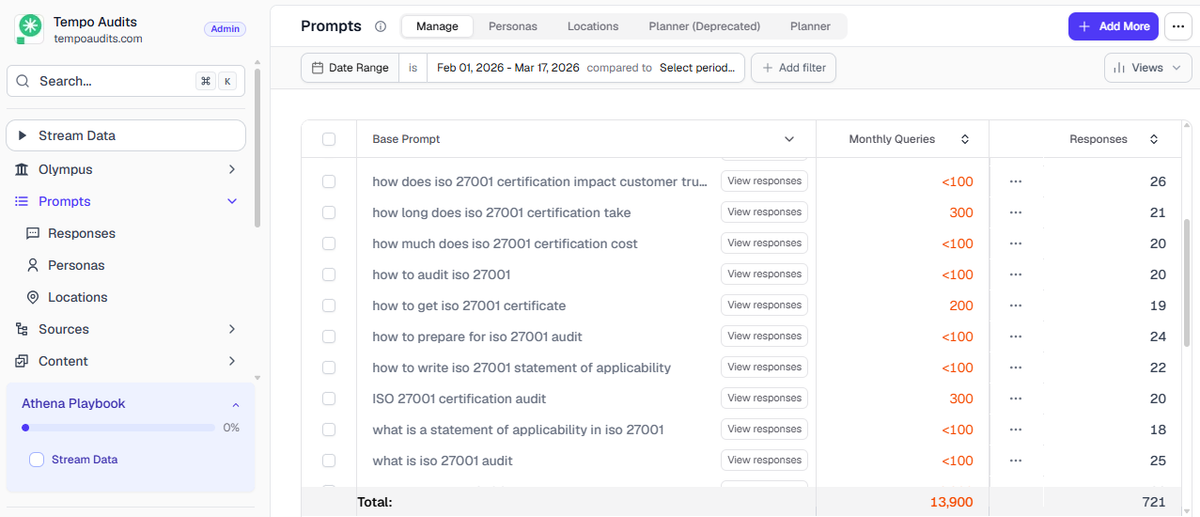
We started by building a prompt list using real search behaviour rather than guessing. We pulled question-based queries (what, why, how, where) from Google Search Console and combined them with Google autocomplete suggestions.
We then grouped and refined these into a focused prompt set before using GEO tools to estimate prompt volumes and track visibility across platforms like ChatGPT and Perplexity.
This approach allowed us to move from scattered queries to a structured, trackable prompt strategy that reflects real user intent and supports ongoing performance tracking.
Step 2 - Performance benchmarking
Next, we measure where you stand today vs competitors.
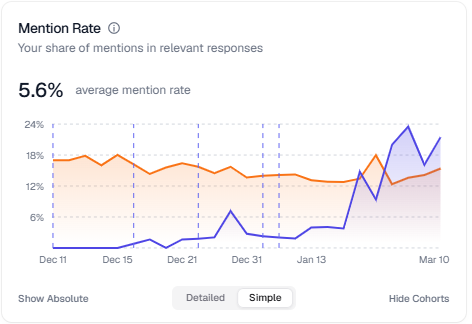
Brand mentions
- How often your brand is mentioned in AI answers
- Compared with competitors
- Broken down by service, product, or topic
Main metrics: Share of Voice (SoV), mention rate.
Citations
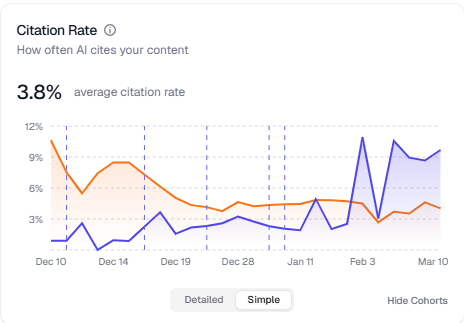
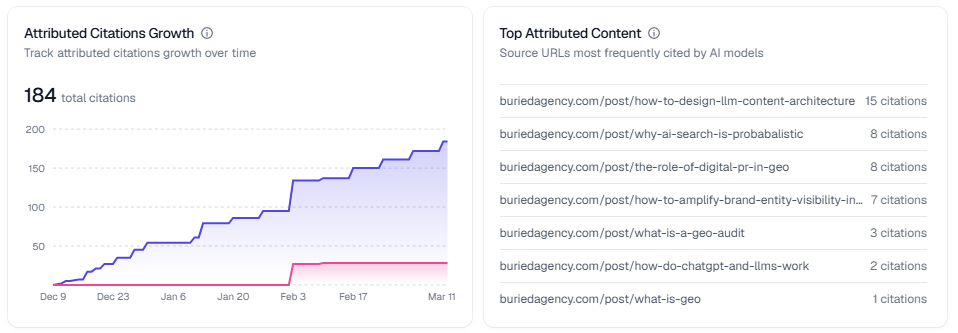
- How often your website is used as a source
- Compared with competitors
- Also broken down by topic
Main metric: Citation rate, attributed citations growth, most cited content.
Why this matters: You get a clear view of:
- Where you’re winning
- Where you’re invisible
- How far behind competitors you are
Step 3 - Gap analysis
Now we connect the dots.
We identify:
- Topics where you perform well
- Topics where you don’t appear at all
Usually, gaps sit around:
- Specific services
- Product categories
- High-intent keywords
Goal: Prioritise what to fix first.
Step 4 - Content benchmarking
This is where strategy becomes actionable.
We analyse:
- What competitors are doing well.
- Why their content is being picked by AI.
Then we create:
- A list of content improvements.
- New content ideas to fill gaps.
How we approached competitor benchmarking for Tempo Audits
The next step we took for Tempo Audits was to identify which competitors were driving the most relevant organic visibility in their space. We created a competitor matrix focused on high non-brand traffic to ensure we analysed businesses competing for the same discovery-stage queries.
We then reviewed their top-performing pages to understand why they ranked well and were surfaced in search and AI results.
This included looking at:
- The type of content driving traffic (guides, service pages, resources)
- How effectively they targeted non-brand, high-intent queries
- How well their content aligned with user needs and search intent
From this, we identified key gaps and opportunities - particularly where competitors were capturing demand that Tempo Audits was missing.
The outcome was a clear set of actionable recommendations to improve visibility across high-impact, non-brand topics.
Step 5 - Entity optimisation (Beyond content)
This is where most businesses go wrong. GEO is not just about content - it’s about trust. AI tools recommend brands they trust.
So we improve a few key things:
Reviews
- More reviews
- Better quality reviews
The more positive signals, the safer AI feels recommending you.
Brand mentions & digital PR
- Mentions on trusted websites
- Industry publications
- Comparisons and roundups
If no one talks about you, AI won’t either. Digital PR plays a critical role in GEO strategy - it is widely considered to be the most powerful form of link building within both SEO & GEO.
Links (authority signals)
- High-quality backlinks
- Coverage on credible platforms
Link building comes in many forms, but it focuses on building your overall brand authority.
Step 6 - GEO readiness score (Technical layer)
We create a GEO readiness score. Here, we focus only on what impacts AI visibility.
This includes:
- Can AI bots access your site?
- Is your content easy to read and extract?
- Do you use structured data (schema)?
- Is your site fast and mobile-friendly?
Think of this as a quick health check for AI visibility. Below is an example of what a typical GEO readiness analysis and score looks like.
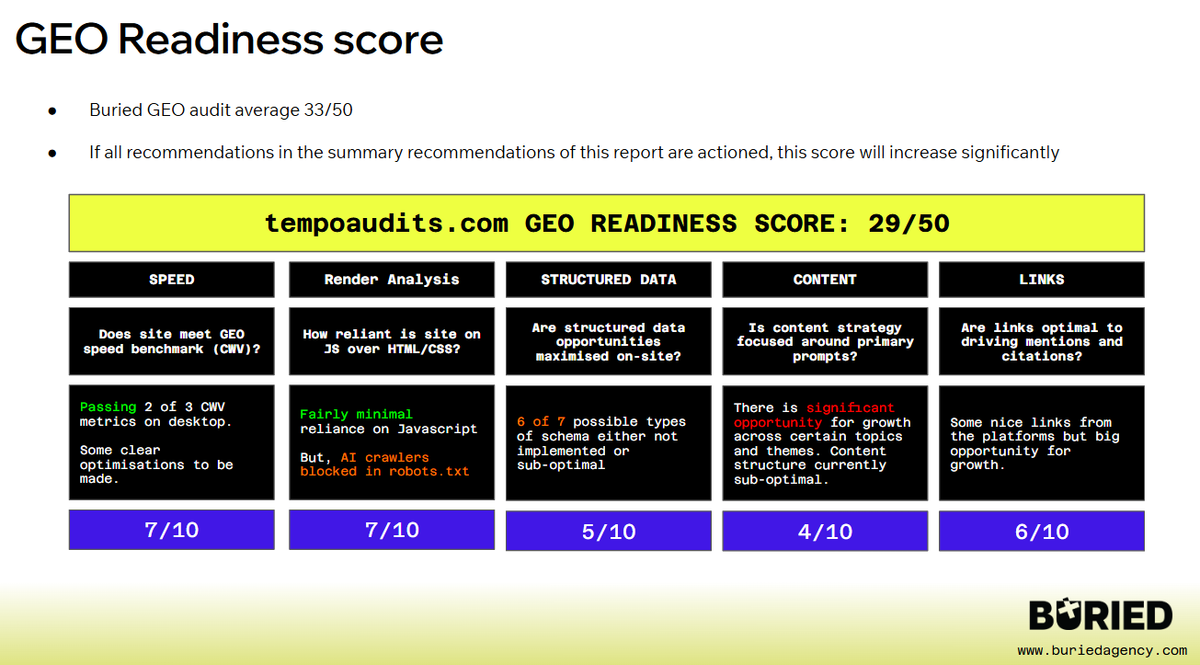
Explaining the areas in the GEO readiness score:
- Speed - How fast your website loads. Faster sites are easier for both users and AI systems to access and prioritise.
- Render analysis - How well your site loads for bots (not just users). If content is hidden or slow to render, AI may struggle to read it.
- Structured data - Whether your site uses schema (extra code that explains your content). This helps AI understand your content more clearly.
- Content - How well your content answers key questions and aligns with user intent. Clear, focused content performs better in AI answers.
- Links - How strong and relevant your internal and external links are. Good linking improves authority and discoverability.
What you get from a GEO audit
At the end of the audit, you should have:
- A full audit document
- A list of target prompts
- Prompt tracking setup (in GEO tool)
- Clear performance benchmarks
- A prioritised action plan
Example GEO audit output
So, what does a GEO audit actually look like in practice?
Below is a simplified example of the kind of insights and actions a business would receive. The goal is simple: turn visibility gaps into clear, actionable steps.
GEO audit findings and actions
| Area | Finding | Recommended action |
|---|---|---|
| Prompt visibility | Brand appears in 6 of 40 tracked prompts (15%). | Expand content targeting high-intent buyer prompts. |
| Competitor citations | Two competitors are cited more frequently in AI answers. | Create comparison and "alternative to" pages. |
| AI citations | Only one blog post is referenced by AI tools. | Optimise key pages with clear, quotable answers. |
| Content gaps | Missing guides for common industry questions. | Publish educational, problem-focused content. |
| Entity clarity | AI describes the brand inconsistently. | Improve service pages and brand positioning. |
| Technical structure | FAQ schema missing on key pages. | Add structured data (FAQ, article schema). |
| Authority signals | Limited mentions on trusted websites. | Invest in digital PR and industry placements. |
| AI crawler access | No major issues detected. | Maintain a clean site structure and monitoring. |
| Priority opportunities | Missing comparison content and expert guides. | Focus on high-impact content and citation growth. |
Tools used in a GEO audit
You don’t need dozens of tools to run a GEO audit. You just need the right mix to test visibility, track performance, and spot gaps.
Here are the key ones:
AI visibility & tracking tools
Used to track -
- How often your brand appears in AI answers
- How frequently it is cited
- How this changes over time
- Where your brand is mentioned across the web
This includes both manual testing (checking prompts yourself) and ongoing tracking across multiple prompts and platforms.
Tool options:
- AthenaHQ
- PeecAI
- Promptwatch
- Otterly.ai
- Profound
- ChatGPT (manual testing)
- Perplexity (also shows sources/citations)
- Ahrefs (brand mentions + backlinks)
2. Structured data validation tools
- Check if your schema (structured data) is set up correctly.
- Helps AI understand your content better.
Tool options:
- Schema Validator
- Rich results
3. Technical accessibility tools
- Ensure your site is readable and accessible to AI bots.
- Check speed, crawlability, and indexing.
Tool options:
- Google Search Console
- PageSpeed Insights
4. Analytics & traffic monitoring tools
- Track traffic and identify visits from AI platforms.
- Helps measure real business impact.
Tool options:
- AthenaHQ (measuring prompt visibility)
- Google Analytics 4 (website traffic and conversions)
5. Content analysis tools
- Improve readability and structure.
- Make content easier for AI to extract and reuse.
Tool options:
- Surfer SEO
- Hemingway Editor
While tools can guide optimisation, they don’t replace human judgment. At Buried, we use experience and editorial thinking to make content clear, useful, and genuinely readable - not just “tool-optimised”.
Read our in-depth article on the best GEO tools.
Final GEO audit checklist
Use this as a quick, practical checklist to assess your AI visibility.
Prompt & visibility
- Identify key AI prompts your target audience would ask
- Test those prompts in ChatGPT and Perplexity
- Check if your brand appears in responses
- Track which competitors are being mentioned
- Measure prompt visibility rate (% of prompts you appear in)
- Track how often your content is cited by AI
Content & structure
- Ensure content includes clear answers and definitions
- Add short, quotable statements AI can reuse
- Structure pages with headings, bullet points, and short sections
- Create content around key buyer questions
- Add stats, data, and credible sources
Entity & authority
- Keep brand description clear and consistent across the web
- Strengthen your brand’s positioning (what you do, who you serve)
- Build mentions on trusted industry websites
- Improve backlinks and digital PR coverage
- Monitor brand mentions using tools like Ahrefs
Technical & accessibility
- Ensure AI crawlers are not blocked in robots.txt
- Implement structured data (Organisation, Article, FAQ)
- Make sure key content is visible in HTML (not hidden in scripts)
- Check site speed and mobile usability
Tracking & optimisation
- Track AI visibility and prompt performance over time
- Monitor citation trends and Share of Voice (SoV)
- Measure AI-driven traffic and conversions
- Create a prioritised roadmap based on audit findings
If you can tick off most of these, you’re in a strong position for AI visibility.
Get a free GEO audit and uncover your AI visibility gaps
If you’re not showing up in AI answers, you’re already losing visibility to competitors.
A GEO audit shows you exactly:
- Where your brand appears (and where it doesn’t)
- Why competitors are being recommended instead
- What actions will improve your visibility and conversions
At Buried, we combine GEO and SEO into one clear strategy, so you’re not just visible, but chosen. Contact us today for a free GEO audit.
Also read - GEO vs AEO vs AI SEO: What’s the difference?
Work with Buried
Get a free GEO audit
See exactly where your brand shows up in AI answers, why competitors get chosen instead, and what to fix first.
Book a callAbout the author
Will Tombs
Founder, Buried
Will Tombs is the Founder of Buried. He’s an award-winning growth marketing specialist and expert in SEO and GEO. With over 12 years’ experience in industry, Will has led digital strategy for: Startups that have gone on to be acquired, international enterprise retailers, and his own e-commerce businesses.
From the blog
Related Posts
Why ChatGPT ignores your site: 5 GEO fixes for CEOs, Founders & Marketing Directors
The common reasons AI skips your brand, and how to fix them.
Will TombsRead →Top 12 GEO (Generative Engine Optimisation) agencies in the UK
Who's doing the strongest generative-engine work, and how to choose.
Will TombsRead →GEO vs SEO - What's the difference and what should you do about it?
Where the two overlap, where they split, and how to run both.
Will TombsRead →