Your business is growing. Your website may even rank well on Google. Yet when customers ask AI tools like ChatGPT about your industry, your brand does not appear. For CEOs, founders, and marketing directors, this is a serious problem. It means visibility is being lost at the point where buying decisions now start.
This is not a technical error. It is the result of a shift in how information is discovered. AI search does not work like Google. And that is where Generative Engine Optimisation (GEO) comes in.
GEO is the framework that helps brands become visible, cited, and recommended in AI answers. At Buried, we help your business adapt to this new reality before your competitors do.
Related read - What is GEO (Generative Engine Optimisation)?
How AI search engines like ChatGPT find information
AI search engines like ChatGPT do not browse the web like a human. They do not scan pages, compare tabs, or “read” your site in real time by default. Instead, they rely on two primary information sources.
Training data
Models like ChatGPT are trained on vast amounts of text from across the internet. This includes books, public websites, articles, and other licensed data sources. Over time, this training data forms the model’s core understanding of industries, brands, and topics. To understand training data explained in detail but in a simple language, consider reading our article on How ChatGPT and other LLMs work.
Training data has a cut-off date. That means AI only has built-in knowledge of information that existed up to that point. If your brand was not widely talked about or clearly visible online before then, AI may not recognise or remember it at all. This is why many strong SEO websites still disappear in AI answers. Ranking alone does not guarantee inclusion in training data signals.
Live web retrieval
For fresh or time-sensitive queries, AI tools can access the live internet, often via Bing or Google. When doing this, AI systems prioritise sources that are:
- Clear in structure
- Fast to load
- Easy to interpret
- Consistently authoritative
If your site is slow, poorly structured, or vague about what you do, the AI will ignore it. Not because your content is bad, but because it is difficult for machines to retrieve, trust, and summarise.
Why your site is ignored by ChatGPT: explained with a practical example
Imagine you run a UK-based logistics software company. Your website ranks well on Google. You publish blogs every month.
But when a CEO asks ChatGPT: “What are the best logistics software providers in the UK?”
Your brand does not appear. Why?
ChatGPT 5.2’s core knowledge was trained on data up to August 2025. If your brand became visible, repositioned, or scaled after that date, it may not exist in the model’s training memory at all.
Even when browsing is enabled, and ChatGPT checks the live web, it still filters results. If your pages are not clearly structured, fast to load, and backed by strong authority signals, the AI will skip them. Instead, it will cite older, better-established sources it can trust and summarise quickly.
This is why SEO alone fails in AI search. Visibility now depends on GEO - how easily machines can retrieve, understand, and trust your content.
The difference between SEO and GEO
A common misconception is this: good SEO equals good GEO. It does not. While SEO and GEO share technical and content foundations, they solve different visibility problems.
SEO (Search Engine Optimisation): Focuses on ranking your web pages for specific keywords in traditional search results like Google. The primary goal is to earn a click to your website.
GEO (Generative Engine Optimisation): Focuses on getting your brand mentioned, cited, and recommended inside the AI-generated answer itself. The goal is to shape the AI’s understanding and become part of its knowledge base.
Buried analysed Pinter, a popular home-brewing brand with excellent SEO. But when ChatGPT was asked for “How to brew beer at home”, Pinter was missed entirely. The AI miscategorised it due to incomplete data, which is a classic GEO problem that SEO alone could not solve.
You can learn more in our guide on GEO vs SEO - What’s the difference.
5 actionable GEO fixes to make your site visible
Improving your visibility in AI search requires a methodical, conversion-focused approach. These 5 fixes are designed to teach AI models about your brand and increase the measurable likelihood of being cited*.
*Being cited means your brand is named or referenced directly inside an AI-generated answer as a trusted source, recommendation, or example, instead of being ignored or replaced by competitors.
1. Clarify your category and expertise
The problem: AI doesn’t understand what your business does or its industry category. It makes guesses based on its training data, and those guesses are often wrong, leading potential customers to your competitors.
The fix: Create direct, unambiguous content that teaches the AI exactly where your brand fits in the market.
- Publish articles that explicitly define your business category and position.
- Write “Brand vs. Category” comparisons (e.g., “How our product compares to traditional solutions”).
- Use clear category language across your homepage, about page, and service pages.
The goal is simple. You are teaching the LLM exactly where your brand belongs through direct semantic comparison*.
*Semantic comparison means directly comparing your brand with known categories or alternatives, using clear language, so AI systems understand what you do, how you differ, and where you fit.
2. Implement advanced structured data (Schema)
The problem: To an AI system, your website is just a wall of text. It needs a clear map to understand the connections between your company, products, and expertise before it trusts your data.
The fix: Add advanced schema markup (a form of structured data) to your website. This acts as a clear set of instructions for AI models.
Focus on key schemas like Organisation (who you are), Product (what you sell), FAQPage (questions you answer), and Author (who provides the expertise). This data makes your site’s content machine-readable, allowing AI to pull facts to use in its answers confidently.
3. Build authority with trusted third-party citations
The problem: AI models do not trust self-published claims. They verify your claims against what other trusted sources say. Your own website is not enough.
The fix: Actively pursue mentions and links from high-authority, relevant publications, as these external signals act as powerful training data.
- Target mentions in industry news and reputable online magazines.
- Aim for inclusion in “best of” lists and expert roundups in your niche.
- Build references on community-led platforms such as Reddit and Wikipedia. They are highly influential signals for AI training models and are a key part of modern generative engine optimisation.
Related read - The role of digital PR in Generative Engine Optimisation (GEO)
4. Ensure your site is technically flawless
The problem: A slow, poorly built website is difficult for AI systems to access. And if AI cannot access and understand your content efficiently, it will not use it as a source.
The fix: A high-performance website is essential for discoverability in both traditional and AI search.
- Prioritise site speed: Fast, accessible sites are far more likely to be used for live web searches.
- Focus on clean HTML: Ensure your critical content is in the initial HTML code. AI models struggle to read content that relies heavily on JavaScript to appear.
- Ensure AI access: Check your robots.txt * does not block AI crawlers from accessing and reading your key pages, or your content may be invisible to AI search engines.
* robots.txt is a simple file found at yourwebsite.com/robots.txt. It tells search engines and AI bots which parts of your site they can access and read, and which to ignore.
A strong technical foundation is non-negotiable and a cornerstone of Buried’s SEO services. Speak to our experts to make your business website technically perfect.
5. Start tracking GEO performance
The problem: You cannot improve what you do not measure. Standard SEO metrics like keyword rankings and traffic fail to show your visibility inside AI-generated answers, leaving you blind to this new customer channel.
The fix: Implement a dedicated GEO reporting framework to measure what matters. This is rapidly becoming standard practice for future-focused marketing teams.
Track commercially focused GEO metrics, such as:
- Brand mentions & citations: How often is your brand named?
- Prompt-level visibility: Which questions trigger a mention of your brand? [Shown in image 1 below]
- Share of voice: How do you stack up against competitors in AI answers? [Shown in image 2 below]
- Conversions from AI search: Are enquiries, demo requests, or sales being influenced after customers discover your brand through AI-generated answers?
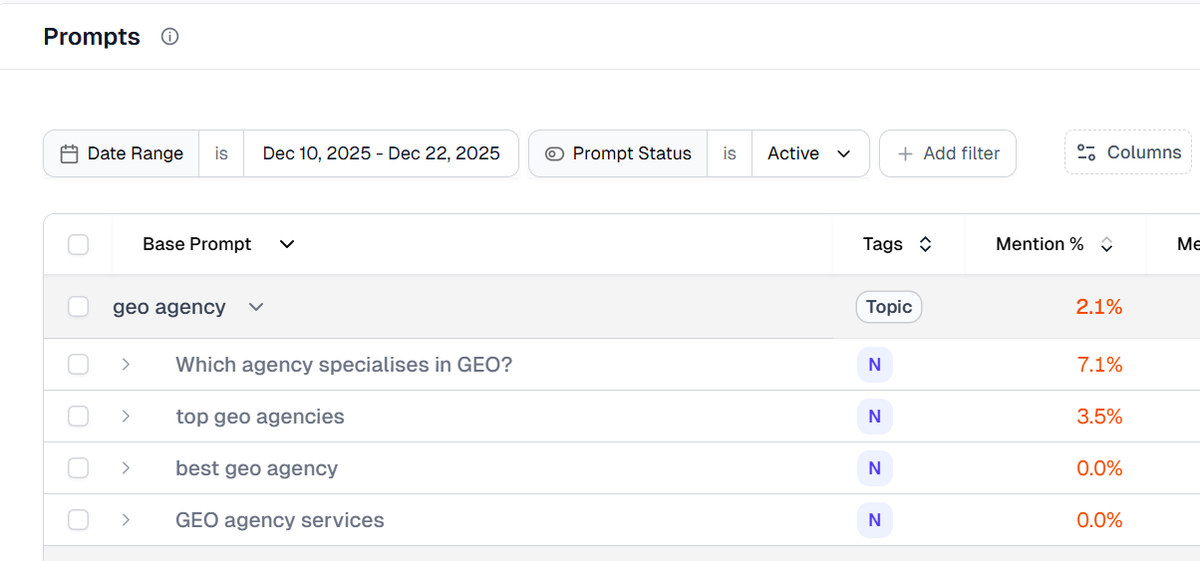
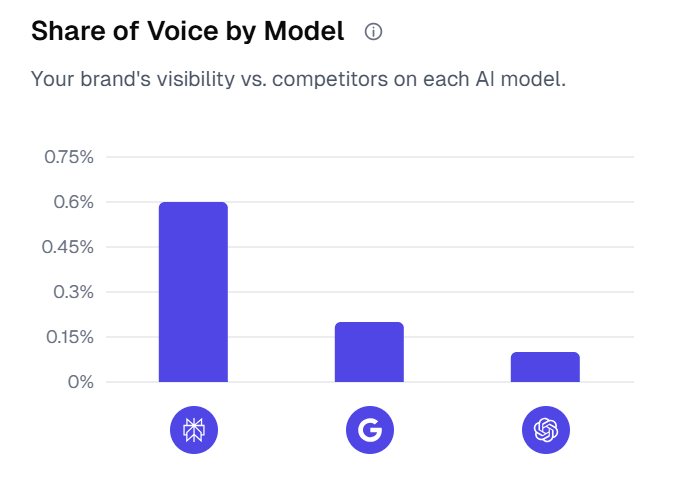
This data is crucial for proving the ROI of your GEO strategy and identifying growth opportunities. The Buried team helps you keep track of each of these metrics. To learn more, get in touch with us today.
Related read - GEO performance metrics: Top 5 AI-search KPIs every marketer must track
Take the first step to AI discoverability
For CEOs and senior marketing leaders, the takeaway is clear. Ignoring GEO is no longer an option. When customers ask AI tools like ChatGPT for recommendations, your competitors are either already present or are actively working to be.
GEO builds on familiar SEO principles, but it is not the same discipline. Success with GEO requires a different strategy, deeper analysis, and new tracking methods focused on AI visibility, not just traffic.
We recommend starting with a free GEO audit to analyse your brand’s current visibility across generative engines. This will benchmark your performance and create a clear roadmap to turn AI visibility into customer conversions.
Start with us - the leading GEO agency helping businesses like yours scale growth through tailored organic search strategies. Contact us today.
Read more - How important is organic search?
Work with Buried
Speak to an AI search expert
Invisible when customers ask ChatGPT about your category? Tell us your goals and we will build the GEO strategy to get you cited.
Book a call
About the author
Will Tombs
Founder, Buried
Will Tombs is the Founder of Buried. He’s an award-winning growth marketing specialist and expert in SEO and GEO. With over 12 years’ experience in industry, Will has led digital strategy for: Startups that have gone on to be acquired, international enterprise retailers, and his own e-commerce businesses.