Contents
- What is Generative Engine Optimisation (GEO)?
- How generative engines work
- GEO vs SEO: Is GEO replacing SEO?
- Why is generative optimisation important for your business?
- Get started with GEO in 3 steps
- Generative AI optimisation best practices
- Generative engine performance tuning: What GEO KPIs should you track?
- Which GEO tools should you use?
- Common GEO mistakes to avoid
- Case study: Pinter - Strong SEO, weak AI visibility
- FAQs
- What is the future of GEO?
What is Generative Engine Optimisation (GEO)?
Generative Engine Optimisation (GEO) is the process of optimising content, so AI tools like ChatGPT, Google AI Overviews, Gemini, Perplexity, and Claude can find, understand, and cite it in their answers.
Think of it this way: SEO helps you rank in search results. GEO helps you become part of the answer.
And that matters because people are searching differently. ChatGPT alone now has more than 900 million weekly active users, with millions of people using AI tools to research products, compare services, and get recommendations before they ever click a website.
If your brand isn’t being cited in those answers, you’re increasingly invisible during some of the most important moments in the buying journey.
What does Generative Engine Optimisation mean in practice?
Someone might search Google for, “How much does a new boiler cost in the UK?” Instead of showing only a list of links, Google AI Overviews may generate a summary answer at the top of the results page, pulling information from multiple sources. If your website is one of the sources cited, your content becomes part of the answer users see first.
That’s GEO in practice. Rather than competing solely for clicks, you’re increasing the chances of your expertise being included in the answer itself.
How generative engines work
Before you can optimise for AI search, it helps to understand how generative engines build their answers. Unlike traditional search engines, which return a list of links, tools like ChatGPT, Perplexity, Claude, and Google AI Overviews generate answers by gathering, interpreting, and combining information from multiple sources.
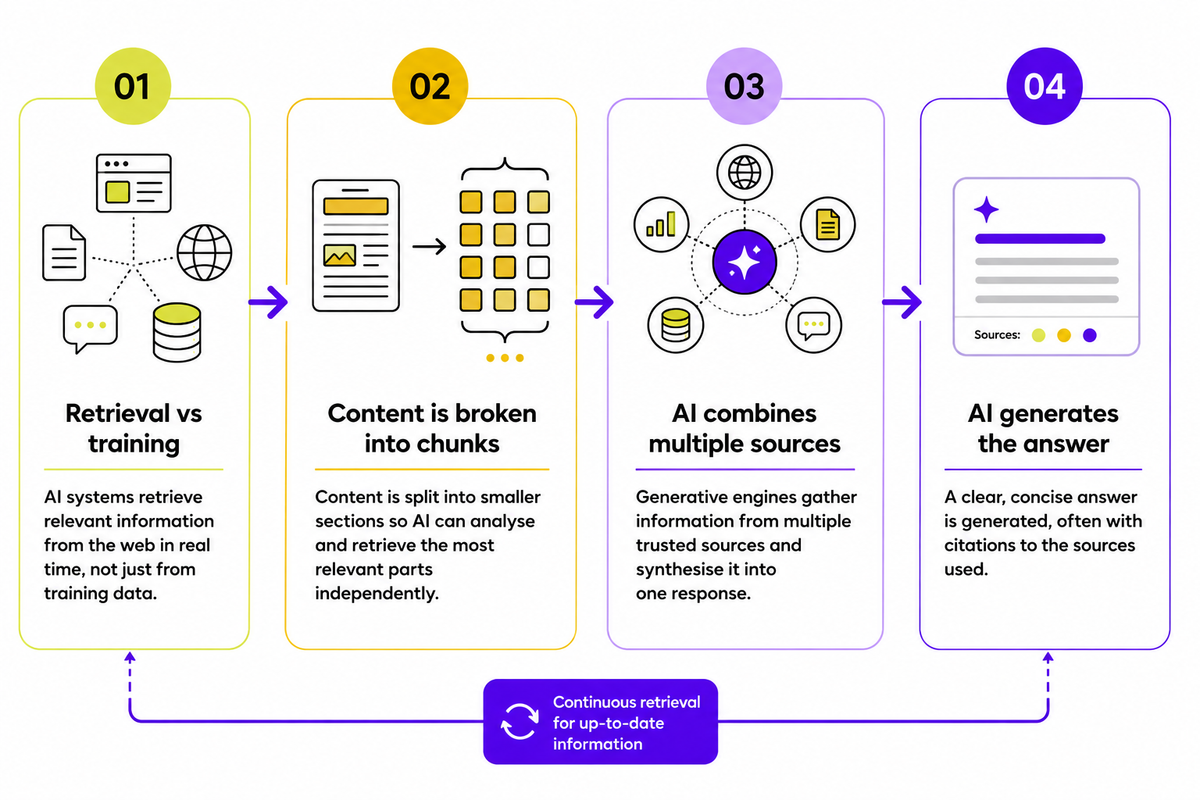
Retrieval vs training
Many people assume AI answers come entirely from a model’s training data. That’s only part of the story. Modern AI systems can also retrieve information from the web in real time. This means your content doesn’t need to have been included in an AI model’s original training data to be cited. It simply needs to be relevant, trustworthy, and easy to find.
If you’re curious about what’s happening behind the scenes, our guide on how ChatGPT works explores the process in more detail - from beginner understanding to advanced!
Content is broken into chunks
AI doesn’t read a webpage from top to bottom like a human. Instead, content is often split into smaller sections, or “chunks”, which can be analysed independently.
A clear definition, a step-by-step list, or a concise explanation can all be retrieved without the AI needing to reference the entire page. This is one reason why clear headings, structured content, and self-contained paragraphs perform well in GEO.
AI combines multiple sources
Most AI-generated answers aren’t taken from a single website. Generative engines gather information from multiple sources, compare it, and identify the most relevant insights. Sources can include industry publications, research studies, forums, news sites, and brand websites.
Content that defines a topic clearly, answers a question directly, and supports claims with evidence is far more likely to be extracted than vague or overly promotional copy.
AI generates the answer
Once the information has been gathered and analysed, the AI creates a single response for the user. Brands that appear consistently across trusted sources are more likely to be recognised as credible authorities and cited within the final answer.
GEO vs SEO: Is GEO replacing SEO?
If you’re wondering whether Generative Engine Optimisation is replacing SEO, the answer is no. At their core, both SEO and GEO are designed to help people discover trustworthy information. The difference is where that visibility happens.
- SEO focuses on rankings in search results
- GEO focuses on earning citations and mentions within AI-generated answers
In fact, Google has confirmed the same, saying, “The best practices for SEO continue to be relevant because our generative AI features on Google Search are rooted in our core Search ranking and quality systems.”
If you’d like a deeper dive, we’ve shared our two cents on Google’s AI search guidance and what it means for brands navigating the shift towards AI-powered search.
Here is a comparison table to help you understand GEO and SEO better.
| Factor | SEO | GEO |
|---|---|---|
| Primary goal | Rank higher in search results | Be cited in AI-generated answers |
| Visibility appears in | Search engine results pages (SERPs) | ChatGPT, Gemini, Claude, Perplexity, AI Overviews |
| Success metric | Rankings, clicks, traffic | Citations, mentions, AI visibility |
| User action | Clicks a link | Receives a direct answer |
| Content focus | Keywords, relevance, backlinks | Authority, extractability, citations |
| Main competitors | Other ranked pages | Other cited sources |
| Best outcome | Top search ranking | Inclusion in the generated answer |
| Importance today | Essential | Increasingly essential |
Why is generative optimisation important for your business?
People are starting their searches with AI
For decades, Google was the default starting point for almost every online search. That’s beginning to change. Recent research found that 37% of consumers now start their searches with AI tools instead of traditional search engines. If your brand isn’t showing up in those conversations, you’re becoming invisible during some of the most important moments in the customer journey.
AI answers are reducing clicks
Generative search experiences are designed to answer questions directly on the results page, often without requiring users to click through to a website. The impact is already showing up in the data. Ahrefs’ latest research found that Google AI Overviews are associated with a 58% reduction in click-through rates for the top-ranking organic result. That’s up from the 34.5% decline the company reported in its earlier study. This was confirmed by Ryan Law, the Director of Content Marketing at Ahrefs, on LinkedIn.
Trust is becoming a competitive advantage
AI platforms assess information from multiple sources and decide which brands, experts, and publications are credible enough to reference. Brands that consistently publish useful content, earn media coverage, attract reviews, and build a strong presence across the web are more likely to be cited when AI generates answers. As search evolves, visibility won’t belong to the loudest brands. It will belong to the most trusted ones.
Get started with GEO in 3 steps
The good news? You don’t need to rebuild your entire marketing strategy overnight. Like SEO in its early days, GEO starts with understanding where you are today, measuring what matters, and making targeted improvements over time.
1. Understand what you need to track
Before you optimise for AI visibility, you need to understand how people are actually discovering businesses like yours through generative search. This starts with prompt research: identifying the questions your prospects ask ChatGPT, Google AI Overviews, Gemini, Claude, and Perplexity throughout the buying journey.
Think beyond obvious commercial queries. Potential customers might ask:
- “What are the best project management tools for remote teams?”
- “Which CRM is best for a growing SaaS company?”
- “How do I choose a digital PR agency?”
Each of these prompts creates an opportunity for AI to recommend, cite, or mention brands. At Buried, we use a prompt research framework to uncover the questions that influence buying decisions and identify where brands are already visible (or completely absent). Read our guide on how to do prompt research to learn the process in detail.
2. Set up tracking in a GEO tool
Once you’ve identified your target prompts, the next step is tracking them. Unlike traditional SEO, where rankings are relatively easy to monitor, GEO requires you to track brand mentions, citations, sentiment, and visibility across AI platforms. Tools such as Athena allow you to monitor whether your brand appears in AI-generated responses and how your visibility changes over time.
Pay particular attention to:
- Brand mentions
- Citations and source links
- Competitor mentions
- Changes in visibility across target prompts
- Which sources AI platforms are referencing
The goal isn’t just to see whether you’re mentioned. You must also understand who is being mentioned ahead of you and why.
3. Optimise for AI visibility
Once you know where you stand, you can start improving your visibility. Most GEO strategies come down to three core areas:
3.1 Content
AI systems need clear signals about what your business does, who it serves, and why it’s different. This means creating content that clearly explains what your business does, who it helps, and what it should be known for.
3.2 Technical foundations
Even great content can struggle if AI systems can’t easily access and understand it. Clear site structure, organised content, schema markup, and descriptive headings make it easier for AI platforms to understand and reference your information.
It’s also worth considering how your website is rendered - meaning information on your website is easily accessible when AI tools visit your pages. Google can process JavaScript effectively, but not every AI platform has the same capabilities, so important content should always be easy to access and interpret.
3.3 Third-party authority
AI models don’t just look at your website. They also look at what the rest of the internet says about you. Think of every mention of your brand as a vote of confidence. Coverage in the media, positive reviews, industry features, podcasts, and expert recommendations all help reinforce your authority.
The stronger those signals are, the more likely AI platforms are to reference your business.
Generative AI optimisation best practices
Many of the techniques that help humans understand your content also help AI systems understand and cite it. Here are some tips and examples from Buried experts.
Use question-based headings
AI platforms are built to answer questions, so structure your content around the questions your audience is actually asking. For example, instead of a heading like “Benefits of Solar Panels”, use “Are Solar Panels Worth It in the UK?” or “How Much Can Solar Panels Save You?” These closely match the prompts people use in AI tools.
Answer the question early
Don’t save the answer for the end of the section. If the question is “How long does a boiler last?”, answer it immediately. A simple opening, such as “Most boilers last between 10 and 15 years”, gives both readers and AI systems the information they’re looking for straight away.
Back up claims with statistics and sources
AI systems are more likely to trust content that is supported by evidence. If you’re writing about electric vehicles, don’t simply claim they’re cheaper to run. Include data from a reputable source showing typical running costs or savings compared to petrol and diesel vehicles.
Use lists, tables, and clear formatting
Large blocks of text are harder for both people and AI systems to process. For example, if you’re comparing different types of mortgages, a simple comparison table is often more useful than several paragraphs explaining the differences.
Keep content updated
AI platforms favour information that is accurate and relevant. If you’re publishing content about tax rates, government grants, or energy prices, review it regularly to ensure the information is still correct. Outdated information is less likely to be trusted or cited.
Implement schema markup
Schema markup gives search engines and AI systems additional context about your content. For example, FAQ schema can help identify questions and answers on a page, while organisation schema helps clarify information about your business.
That said, many GEO practitioners now see schema as a supporting signal rather than a major ranking factor. Well-structured content and strong authority signals are likely to have a greater impact on AI visibility.
Think of schema as a useful extra layer, not a substitute for creating content that AI can easily understand and trust.
Generative engine performance tuning: What GEO KPIs should you track?
Just as SEO relies on rankings, traffic, and conversions, GEO requires its own set of performance metrics. Here are five GEO KPIs worth tracking:
Brand mention visibility
How often does your brand appear in AI-generated responses for your target prompts? This is often the first sign that your GEO efforts are working. If your brand isn’t being mentioned, you’re unlikely to influence the conversation.
Citation visibility
Being mentioned is good. Being cited is even better. Track how often AI platforms reference your website, content, or brand as a source. Citations are one of the strongest indicators that AI systems trust your information.
Share of Voice (SOV)
Share of Voice measures how often your brand appears compared to competitors across a set of target prompts. For example, if competitors are consistently being recommended while your brand is absent, you’ve identified a visibility gap that needs addressing.
Sentiment and accuracy
Being mentioned is great - but exactly how are you being mentioned? Monitor whether AI platforms describe your products, services, and expertise accurately. You should also track sentiment to understand whether mentions are positive, neutral, or negative.
AI traffic and conversions
Ultimately, visibility only matters if it contributes to business outcomes. Tools like Google Analytics 4 can help you monitor traffic from AI platforms and understand whether it’s generating leads, sales, or other meaningful business outcomes.
Which GEO tools should you use?
The GEO tooling landscape is evolving quickly, but you don’t need an enterprise budget to get started. Most businesses can gain valuable insights from a combination of GEO tracking tools and traditional analytics platforms.
- AthenaHQ - Tracks AI visibility, citations, mentions, and competitor performance across major AI platforms.
- Peec AI - Helps monitor brand mentions, AI search visibility, and Share of Voice across target prompts.
- Promptwatch - Useful for tracking how AI models respond to specific prompts and monitoring changes over time.
- Otterly AI - One of the most accessible GEO tools for beginners, offering prompt tracking, brand mentions, and citation monitoring.
- Profound - An enterprise-focused platform designed for large-scale AI visibility tracking and reporting.
- Google Analytics 4 (GA4) - Helps identify traffic and conversions generated by AI platforms, allowing you to connect GEO activity to business outcomes.
- Ahrefs Brand Radar & AI Overviews Tracker - Useful for monitoring AI Overview visibility alongside traditional search performance.
The best tool depends on your goals. If you’re just getting started, Otterly AI and GA4 are often enough to establish a baseline. As your GEO strategy matures, platforms like AthenaHQ and Peec AI can provide deeper competitive insights. For a detailed comparison of features and use cases, read our complete guide to GEO tools.
Common GEO mistakes to avoid
Most GEO mistakes are caused by applying old SEO habits to a new search environment.
Treating GEO like keyword optimisation
Keywords still matter, but stuffing exact-match phrases into every heading won’t help you get cited. AI platforms are trying to answer questions, not count keyword occurrences. Focus on creating genuinely useful content that answers the questions your audience is asking.
Making content hard to understand
If a human has to work hard to find the answer, AI probably will too. Pages with unclear headings, overly long introductions, and poor formatting make it harder for AI systems to identify the information worth referencing.
Simple, well-structured content usually wins.
Assuming your website is enough
Many businesses invest heavily in their website and ignore everything else. The problem is that AI doesn’t just look at your site. It also looks at reviews, media coverage, industry publications, forums, and other third-party sources when deciding which brands to trust.
Chasing visibility without building credibility
If competitors are consistently being cited ahead of you, there’s usually a reason. They may have stronger expertise signals, more brand mentions, better reviews, or greater recognition within their industry.
Case study: Pinter - Strong SEO, weak AI visibility
The challenge
Pinter, a home beer brewing brand, was already performing well in traditional search. The company ranked highly for terms such as “beer brewing machine” and “brew your own beer kit”, giving it strong visibility across its core market.
However, when tested against AI prompts such as “How do I brew beer at home?” and “What’s the easiest home brewing method?”, Pinter was often missing from the answers. Instead, AI platforms recommended competitors and traditional brewing kits. This highlights an important GEO challenge: ranking well in Google doesn’t automatically mean you’ll be recommended by AI.
The insight
Although AI models recognised Pinter as a beer-related product, they didn’t consistently understand its position within the home brewing category.
As a result, the brand wasn’t being retrieved when users asked relevant questions.
The GEO approach
Instead of focusing on rankings, we focused on helping AI better understand where Pinter fits within the category. To do that, we:
- Identified the prompts where Pinter should have appeared but wasn’t
- Created content around home brewing topics, alternatives, and comparisons
- Strengthened category signals across key pages, FAQs, and supporting content
- Increased visibility through trusted third-party mentions and recommendations
- Encouraged reviews and community discussions that reinforced the brand’s positioning
The results
After implementing these changes, Pinter’s visibility across AI platforms began to improve. The brand appeared more frequently for relevant prompts, earned more citations in AI-generated responses, and increased its Share of Voice against competing solutions.
The screenshot below shows exactly what GEO success looks like in practice. Pinter is now being surfaced within AI-generated search experiences for relevant brewing queries.
FAQs
Which platforms should you optimise for in GEO?
Focus on the platforms your audience actually uses. For most businesses, that means ChatGPT, Google AI Overviews, Gemini, Claude, and Perplexity. Each platform works differently, but the core principles of authority, clarity, and trust remain the same.
Can small businesses benefit from Generative Engine Optimisation?
Absolutely. AI platforms don’t only recommend big brands. Smaller businesses can earn visibility by publishing helpful content, building authority in their niche, and creating strong signals across their website and the wider web.
What type of content performs best for GEO?
Content that answers specific questions tends to perform best. Clear explanations, how-to guides, comparisons, FAQs, research, and expert insights are all easier for AI systems to understand, extract, and reference in responses.
Can AI-generated content be used for GEO?
Yes, but it shouldn’t be published without human input. AI can help with research and drafting, but content still needs expert knowledge, original insights, fact-checking, and a clear point of view to earn trust and citations.
Does AI search favour large, well-known brands, or does GEO level the playing field?
Established brands often have an advantage because they are mentioned more frequently across trusted sources. However, smaller businesses can still compete by demonstrating expertise, earning third-party mentions, and creating genuinely useful content that answers users’ questions.
What is the future of GEO?
AI search is still in its early stages, but the direction of travel is clear. More people are turning to ChatGPT, Google AI Overviews, Gemini, Claude, and Perplexity to research products, compare options, and find answers.
At the same time, traditional search is becoming more answer-driven, reducing the number of clicks flowing to websites. That doesn’t mean SEO is disappearing. It just means search visibility is expanding beyond rankings alone.
The brands that start investing in GEO today have an opportunity to build authority, earn citations, and establish themselves as trusted sources before the space becomes significantly more competitive.
If you’re ready to understand how visible your brand is across AI platforms and what it will take to improve it, get in touch with Buried. We’d be happy to help you build a GEO strategy that delivers measurable results.
Work with Buried
Speak to an AI search expert
Want to know how visible your brand is across ChatGPT, Gemini, and AI Overviews? Tell us your goals and we will build a GEO strategy that delivers measurable results.
Book a call
About the author
Will Tombs
Founder, Buried
Will Tombs is the Founder of Buried. He’s an award-winning growth marketing specialist and expert in SEO and GEO. With over 12 years’ experience in industry, Will has led digital strategy for: Startups that have gone on to be acquired, international enterprise retailers, and his own e-commerce businesses.
From the blog
Related Posts
GEO vs SEO: What's the difference?
Where each discipline wins, and why the smartest brands run both together.
Will TombsRead →How to do prompt research: The 4-step guide
Find the AI prompts your buyers actually use, and where you are missing.
Will TombsRead →Top GEO tools compared
The tracking tools worth your budget, from free baselines to enterprise.
Will TombsRead →