What are GEO, AEO, and AI SEO?
Search is going through a fundamental shift. And with that shift comes a wave of new acronyms. GEO, AEO, and AI SEO are three terms that now appear across marketing discussions.
At first glance, they can feel confusing or even competing.
In reality, they all point to the same core idea.
GEO (Generative Engine Optimisation), AEO (Answer Engine Optimisation), and AI SEO (AI Search Engine Optimisation) describe the practice of optimising a brand’s content and online presence so it is visible and referenced within AI-driven search engines. These include platforms such as ChatGPT, Perplexity, Google Gemini, Google AI Mode, and Claude.
Instead of ranking links, these systems generate answers. They decide which brands, sources, and viewpoints to include in those responses.
For simplicity and consistency, this article will use the term GEO. In it, you will learn how GEO, AEO, and AI SEO differ from traditional SEO, and what your business should focus on next.
How do these differ from traditional SEO?
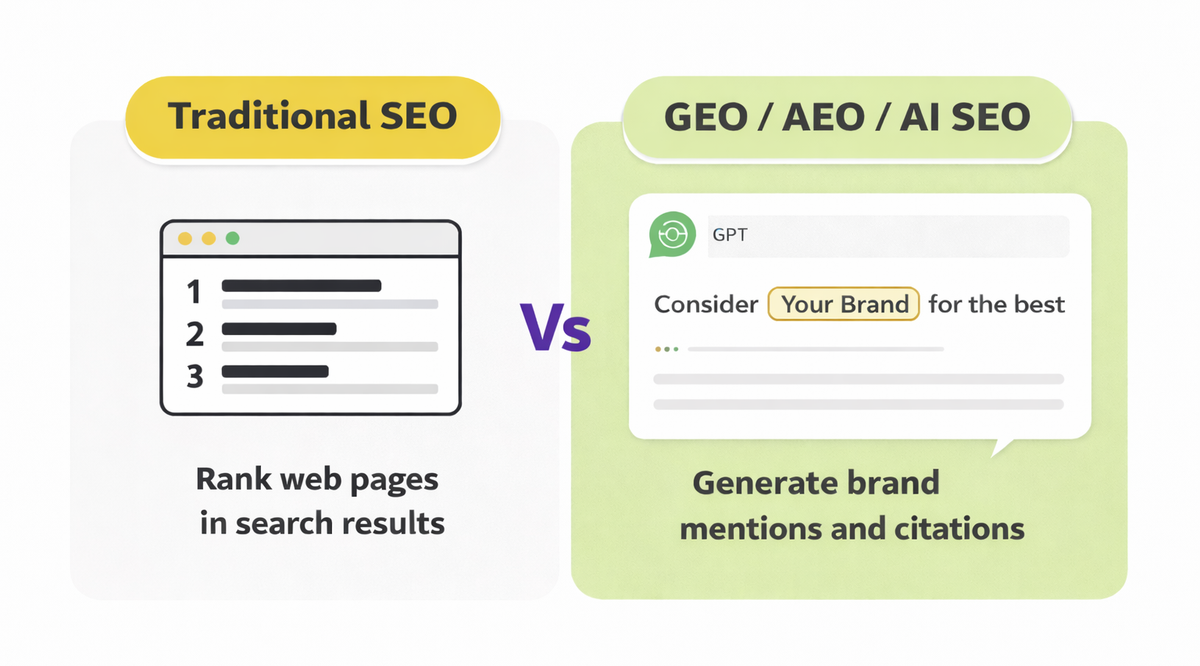
Traditional SEO, or Search Engine Optimisation, focuses on improving a website’s visibility in classic search engines such as Google.
The aim is simple. When someone searches for a keyword, your page should appear as high as possible on the search results page.
SEO is built on three core pillars: content, technical foundations, and authority. Content answers search queries. Technical SEO ensures search engines can crawl (discover) and understand your site. Authority is built through links and brand trust across the web. Together, these pillars form the basis of professional SEO services.
The primary goal of SEO is to rank specific URLs for keyword-based searches. Success is measured by positions, traffic, and clicks.
GEO works differently. Instead of ranking pages, the goal is to ensure your brand is included, cited (used as a trusted source), and recommended within AI-generated answers.
Other SEO specialisms: The intersection where AI search meets local SEO
What is local SEO?
Search optimisation has always evolved through specialisms. Local SEO is a good example. Local SEO focuses on improving a business’s visibility in location-based search results. It helps search engines understand where a business operates and who it serves.
This is essential for companies with physical locations, such as shops, offices, or clinics. It is also vital for service businesses that operate within defined geographic areas.
Typical local searches include phrases like “coffee shop near me” or “plumber in Manchester”. In these cases, search engines prioritise relevance, distance, and local trust signals.
Local SEO involves optimising business listings, location pages, reviews, and local authority signals.
Where AI search and local SEO meet
Search is no longer split neatly between “traditional” and “local.” AI is now playing a growing role in how people ask location-based questions and how answers are delivered.
AI-driven search tools are increasingly used to respond to prompts such as “best accountant near me” or “top SEO and GEO agency in Bristol.” Instead of showing a list of nearby businesses, these systems generate direct recommendations.
This shift has given rise to what many now call Local GEO.
The 2026 Local Search Ranking Factors survey, based on responses from 47 local SEO experts, added a brand-new category called “AI Search visibility impact” alongside traditional local search signals like Google Business Profile and reviews. This shows that experts now actively track how AI affects local search visibility and recommendations - something that simply wasn’t measured in earlier editions of the report.
AI is no longer experimental. It is becoming a measurable influence on local discovery. For businesses that rely on local demand, this intersection between AI search and Local SEO is becoming impossible to ignore.
What should your business focus on?
An effective organic search strategy is not about choosing between SEO and GEO, but instead working on them together.
AI systems still rely on the same high-quality signals that traditional SEO prompts; the main difference in understanding SEO and GEO success is the measurement layer. Tracking keywords and prompts is fundamentally different, and your tracking needs to consider this. Once you have this in place, you’ll often find the insights and recommendations you generate from your reports have a huge amount of crossover.
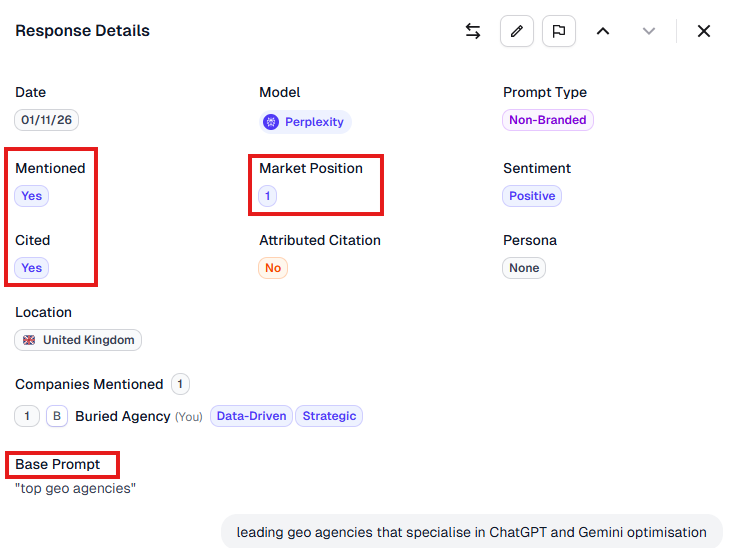
A practical first step is to start tracking how your brand appears in AI-driven search tools. This gives you a clear baseline and shows where gaps exist. This Buried guide to the best GEO and AEO tools for AI search optimisation is a useful starting point for selecting the right platforms.
At Buried, we utilise GEO tools like Athena and Peec AI to track GEO performance, including mentions and citations across AI tools, share of voice, sentiment, and more.
Work with Buried
Speak to an AI search expert
Ready to build visibility in AI search? Tell us your goals and we will shape the SEO and GEO strategy to reach them.
Book a call
About the author
Will Tombs
Founder, Buried
Will Tombs is the Founder of Buried. He’s an award-winning growth marketing specialist and expert in SEO and GEO. With over 12 years’ experience in industry, Will has led digital strategy for: Startups that have gone on to be acquired, international enterprise retailers, and his own e-commerce businesses.
From the blog
Related Posts
What is Generative Engine Optimisation?
The what, why and how of getting started with GEO.
Will TombsRead →Comparing the best GEO tools in 2025
The platforms built to measure AI search visibility, tested.
Will TombsRead →GEO vs SEO - What's the difference and what should you do about it?
Where the two overlap, where they split, and how to run both.
Will TombsRead →