For the past year or so, the SEO world has been in full panic mode over AI search. Suddenly, it was all about GEO, AEO, llms.txt files, “AI-first content”, chunking strategies, and whatever new acronym LinkedIn decided to invent that week.
Now, Google has finally stepped in with official guidance around generative AI features in Search, including AI Overviews and AI Mode, and honestly, the message is refreshingly simple: good SEO fundamentals still matter.
In fact, Google’s recommendations are what we’re already doing at Buried. Long before GEO became the industry buzzword, our approach already focused on creating genuinely useful content, improving technical performance, strengthening user experience, and building websites people enjoy using.
Because while AI search is definitely changing how users discover information, it is not replacing the fundamentals behind great visibility online.
So…is GEO replacing SEO?
Short answer? No, GEO is an extension of SEO.
Despite all the noise around Generative Engine Optimisation and Answer Engine Optimisation, Google’s latest guidance makes one thing very clear: optimising for their AI search experiences is still very much about SEO.
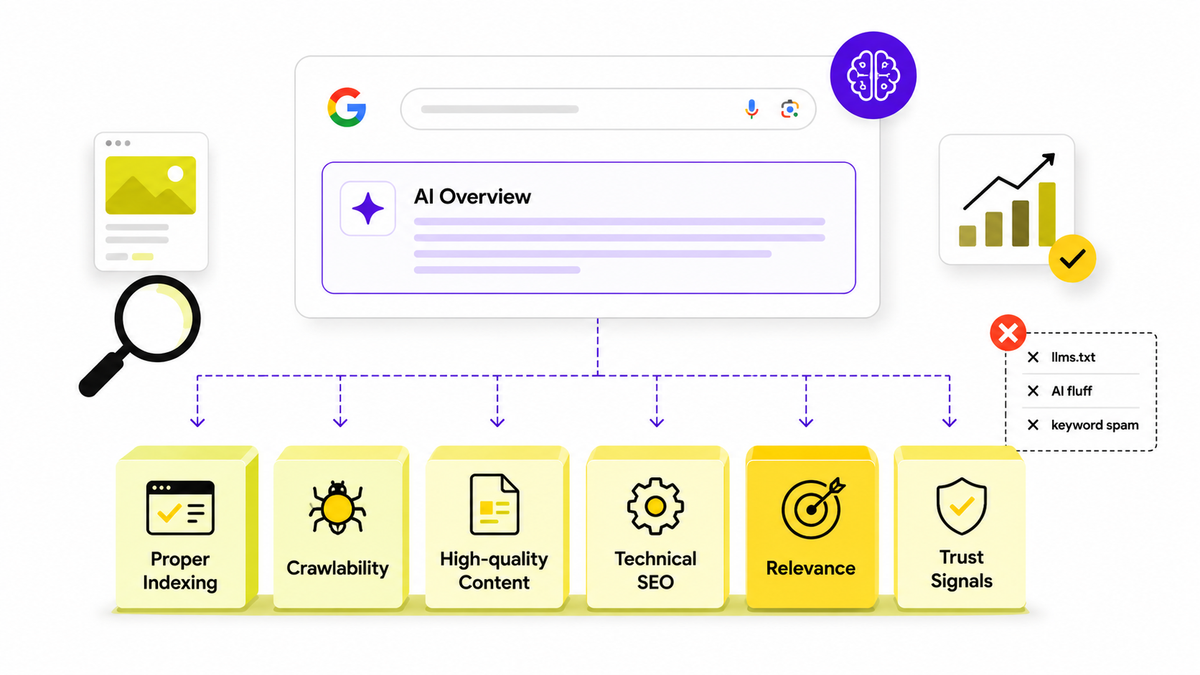
AI Overviews and other generative search features still rely on the same foundations Google has always cared about:
- Proper indexing
- Crawlability
- High-quality content
- Technical SEO
- Relevance
- Trust signals
How Google’s AI search actually works
To explain this further, Google even outlined some of the systems powering its AI search experiences. Interestingly, they still rely heavily on traditional search infrastructure underneath.
Retrieval-Augmented Generation (RAG)
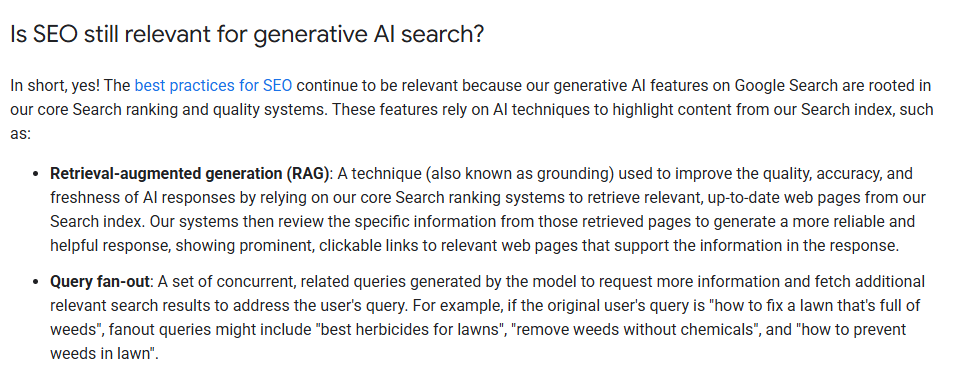
Google explains that its AI responses use something called Retrieval-Augmented Generation (RAG). Put simply, Google’s AI still pulls information from its existing search index before generating answers.
So yes, AI search may look different - but it still depends on strong, accessible, high-quality websites underneath.
Query fan-out
Google also references “query fan-out”, where its systems explore related searches behind the scenes to better understand user intent.
So, if someone searches:
“how to improve local SEO”
Google may also analyse topics around:
- Technical SEO
- Google Business Profiles
- Content quality
- User experience
…before generating a response.
In other words, AI search is changing the presentation layer, not replacing the foundations underneath it.
What matters, according to Google?
Once you strip away the AI buzzwords, Google’s guidance is actually pretty straightforward. The focus is still on building websites and content that real people genuinely find useful.
That includes:
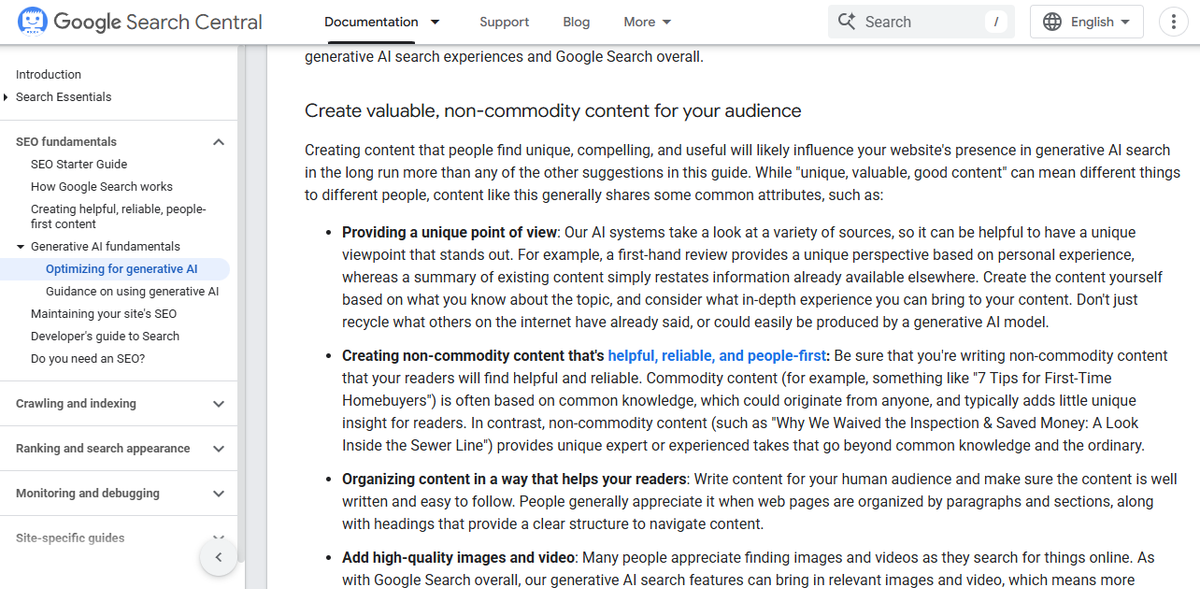
- Unique perspectives and first-hand expertise
- Non-commodity content with actual value
- Strong technical SEO foundations
- Good user experience
- Accessibility across devices and users
- Fast-loading, well-rendered websites
- Crawlability and proper indexing
- High-quality images and video
- Trustworthy, people-first content
Google also puts noticeable emphasis on originality. Earlier, plenty of websites could rank by repeating the same information in slightly different ways. That is becoming far less effective in AI-driven search experiences.
Now, unique insights, subject matter expertise, and genuinely helpful content matter much more.
In other words? It’s the same things good SEOs have been banging on about for years.
What you can stop worrying about
Google’s guidance also quietly debunks a lot of the “AI SEO hacks” floating around online right now.
According to Google, you do not need:
- llms.txt files
- Separate AI-only versions of content
- Aggressively “chunked” pages (content broken into small chunks)
- Endless long-tail keyword variations
- Awkward AI-written filler content
Turns out the robots don’t want robot content either.
This part stood out to us in particular because we’ve never believed in implementing trends simply because SEO tools or social posts say so. Even with growing industry hype around things like llms.txt, our focus has always stayed on evidence-led best practices and real user value.
The strategy should always start with the potential customer:
- What are they actually searching for?
- What format helps them most?
- What experience makes the content easier to understand?
That usually matters far more than chasing technical gimmicks designed purely for algorithms or AI systems.
The real shift: Originality matters more than ever now!
This is probably the biggest shift hiding underneath Google’s guidance.
AI search is getting very good at summarising common information. Which means content that simply repeats what already exists online is becoming far less valuable.
Earlier, many websites could rank by saying the same thing in slightly different ways. Now, Google is placing much more importance on:
- Original insights
- Real expertise
- First-hand experience
- Genuine perspectives
That could mean:
- Sharing actual business experience
- Adding expert commentary
- Using real examples
- Including useful visuals or videos
- Offering opinions that go beyond generic summaries
In short, non-commodity content is essential now.
SEO + GEO - They should work together
At its core, GEO is not replacing SEO. It is simply an evolution in how users discover information. The businesses that perform well in AI search will likely be the ones already investing in:
- Visibility
- Trust
- Technical quality
- User experience
- Genuinely useful content
That is why reviewing the full user journey is crucial for both SEO and GEO. Tools like Microsoft Clarity can help businesses understand how users actually interact with their website and content in real time, including where people drop off, struggle, or engage most.
Technical performance matters as well. While Google says it can process JavaScript-heavy websites, reducing unnecessary JS where possible can still improve:
- Accessibility (how accessible your content is)
- Rendering (how Google reads your pages)
- Speed
- Crawlability (how Google discovers your pages)
- Overall user experience
Buried has been building for this all along
Google’s latest guidance largely confirms the approach we’ve already been following at Buried: focus on users first, and the visibility follows. Our SEO and GEO methodology has always worked as a single integrated strategy built around high-quality content, technical hygiene, accessibility, rendering, crawlability, and genuine subject-matter expertise.
We focus heavily on user journeys, performance, and creating content people actually enjoy consuming - not content written purely for algorithms or AI systems. We also include technical GEO readiness within our GEO audits, including how accessible websites are for emerging agentic AI systems.
Work with Buried
Speak to an AI search expert
Want your SEO fundamentals working for AI search too? Tell us your goals and we will build a single strategy for search and generative engines.
Book a call
About the author
Will Tombs
Founder, Buried
Will Tombs is the Founder of Buried. He’s an award-winning growth marketing specialist and expert in SEO and GEO. With over 12 years’ experience in industry, Will has led digital strategy for: Startups that have gone on to be acquired, international enterprise retailers, and his own e-commerce businesses.
From the blog
Related Posts
The Condé Nast CEO is only half right about AI
Why product and service brands must not plan as if search is zero.
Will TombsRead →GEO vs SEO - What’s the difference?
The core similarities and differences between traditional and AI search.
Will TombsRead →What is Generative Engine Optimisation?
A plain-English guide to GEO and how to get started.
Will TombsRead →