Why LLM brand visibility matters and how brand entity recognition affects this
Search behaviour is changing fast. Instead of scrolling through lists of links, users are increasingly turning to AI-powered platforms like ChatGPT, Perplexity, Claude, and Google Gemini for direct answers, comparisons, and recommendations.
In these environments, visibility no longer comes from ranking for keywords alone. It comes from being recognised and referenced by AI systems inside their generated responses. If your brand is not mentioned or recommended, it effectively does not exist at the point of decision.
This is where brand entities come in. A brand entity is how an AI model understands and represents your business as a distinct, real-world organisation, including who you are, what you do, who you serve, and when you are relevant. Large language models rely on entity recognition to decide which brands to include, describe, or recommend when answering user prompts.
When a brand’s entity is weak or unclear, AI systems may ignore it, misrepresent it, or default to competitors with stronger signals. As AI-led discovery grows, poor entity recognition means lost visibility, even if your SEO rankings remain strong.
The solution is Generative Engine Optimisation (GEO): a strategic, data-led approach focused on strengthening how AI models recognise, understand, and trust your brand. As a UK-based organic search agency specialising in GEO, this is where we see the biggest shift happening right now.
In this article, we break down five practical steps to amplify your LLM brand entity visibility, explaining how AI models recognise brands, why entity visibility matters, and how to ensure your brand consistently appears in AI-generated answers.
How LLMs “see” brands: Understanding entity recognition
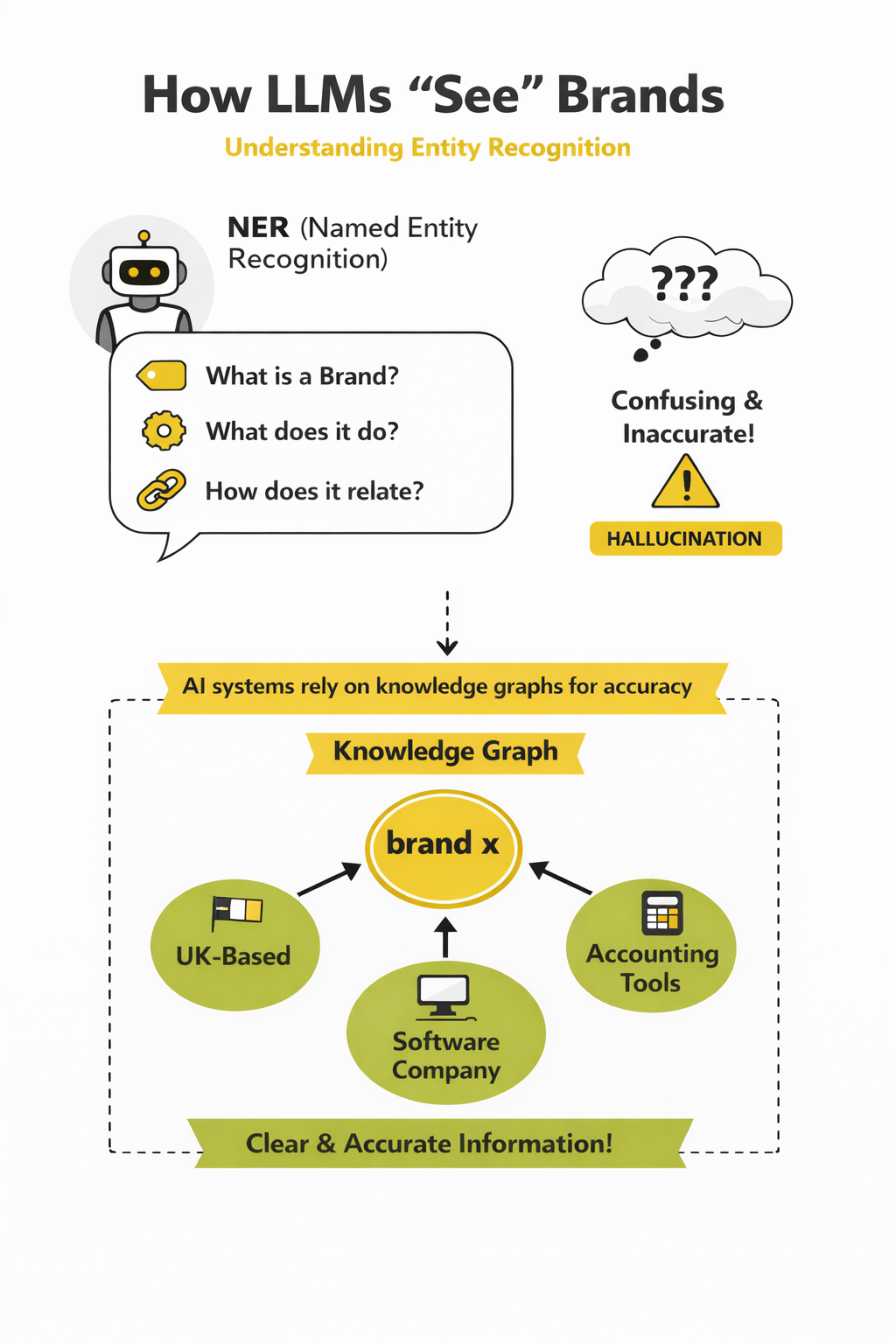
Large Language Models rely on Named Entity Recognition (NER) to identify and classify entities such as brands, products, locations, and people within text.
In simple terms, NER helps AI systems decide what is a brand, what it does, and how it relates to other concepts.
However, NER is not perfect. LLMs can still struggle with ambiguity, incomplete data, or conflicting signals, which can lead to hallucinations or inaccurate brand descriptions.
To combat this, AI systems increasingly rely on knowledge graphs. A knowledge graph is a structured map of entities and their relationships. A well-defined graph helps an LLM understand, for instance, that “Brand X” is a “UK-based software company” that “sells accounting tools.” This structure dramatically reduces ambiguity and improves the accuracy of data recall* about your brand.
*Data recall is the ability to retrieve accurate information when needed.
Related read - How ChatGPT and other LLMs work?
5 data-driven steps to boost your brand’s LLM visibility
Step 1: Audit your current entity footprint
Before improving LLM brand visibility, you need a clear baseline. This starts with a comprehensive GEO audit. Without it, brands are optimising in the dark.
A GEO audit evaluates how your brand is currently understood and represented across AI-powered generative engines. It highlights where AI systems already recognise you, and where they do not.
Key areas to analyse include:
- Brand presence across generative engines - How your brand appears in tools like ChatGPT, Perplexity, and Gemini.
- Citation frequency and quality - How often your brand is mentioned, and whether those mentions are accurate and contextual.
- Structured data and schema coverage - Whether your website provides clear, machine-readable signals about your brand, services, and expertise.
- Authority signals - Existing backlinks, media mentions, and third-party references that influence AI trust.
This audit quickly exposes visibility gaps, misrepresentation risks, and missed citation opportunities. It also provides a prioritised roadmap for improving how AI systems discover and reference your brand, making it the foundation of any effective GEO strategy.
Related read - Data-driven brand mention tactics to dominate LLM search
Step 2: Implement advanced schema and structured data
Structured data* acts as a clear set of instructions for AI models. It removes ambiguity and helps LLMs accurately understand your brand, products, and services.
Advanced schema* and entity markup* go further by defining relationships between entities, reinforcing topical authority. In effect, this builds an enterprise knowledge graph for your brand that AI can easily interpret and trust.
This work sits at the core of strong technical SEO, which is why schema implementation is foundational to Buried’s SEO services.
Related definitions:
*Structured data is a simple way of organising website information so AI and search engines can read, interpret, and trust it correctly.
*Advanced schema is like adding clear labels and instructions to your website so AI can easily understand who you are, what you offer, and how everything connects.
*Entity markup clearly tells AI systems what each important thing on your site represents, such as your brand, services, locations, and how they relate.
Step 3: Develop authoritative, expert content
Instead of writing only for keywords, shift towards creating expert-led content that clearly answers real business questions. Leverage the expertise within your business to create content which is valuable for your audience.
Authoritative content signals E-E-A-T (experience, expertise, authoritativeness, and trustworthiness), which remains a critical factor for both traditional search engines and LLMs. AI systems are far more likely to cite content that demonstrates first-hand knowledge and clear subject ownership.
Content formats that perform particularly well for GEO include:
- In-depth, expert-led guides that solve a user’s problem completely.
- Comparative listicles (“Top 10,” “Best X for Y”) where your brand is favourably positioned.
- Data-driven reports and original research that establish you as an industry authority.
Data from analysis of 2.6 billion AI citations in 2025 shows that comparative/listicle formats account for over 25% of all citations in AI-generated answers, far outperforming traditional blog posts (~12%).
For inspiration, explore Buried’s latest content in its GEO, AEO & AI Search insights.
Step 4: Build authority with high-quality links
LLMs do not rely on your website alone to judge credibility. They validate brands using external signals from trusted third-party sources. These signals help AI systems decide whether your brand deserves to be cited in answers.
High-impact link sources include:
- High-authority publications and trade media
- Digital PR
- Relevant industry forums and expert communities
When trusted sources describe your brand clearly and accurately, LLMs gain confidence in who you are, what you do, and when to recommend you.
Step 5: Track, measure, and refine your performance
GEO demands a different approach to measurement. Traditional SEO metrics alone cannot show how your brand performs inside AI-generated answers. Instead, brands must track clear GEO performance metrics to assess how LLMs reference, describe, and recommend them.
Key metrics to monitor include:
| Metric | Description | Commercial impact |
|---|---|---|
| Brand mentions | Frequency of your brand name appearing in LLM answers. | Measures awareness in the AI channel. |
| Citation quality | The authority of sources the LLM cites alongside your brand. | Indicates the level of trust and authority being conferred. |
| Mention sentiment | The positive, neutral, or negative context of your brand mention. | Tracks brand reputation and perception within AI answers. |
| Share of voice | Your brand mention visibility compared to key competitors for target prompts. | Benchmarks competitive positioning and market share. |
Without a clear reporting framework, this data remains only noise. This is where specialist measurement from an experienced organic search analytics agency becomes essential.
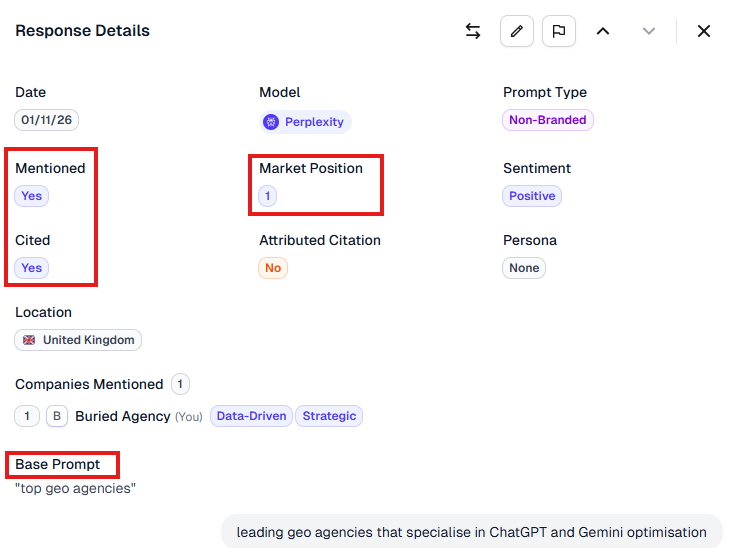
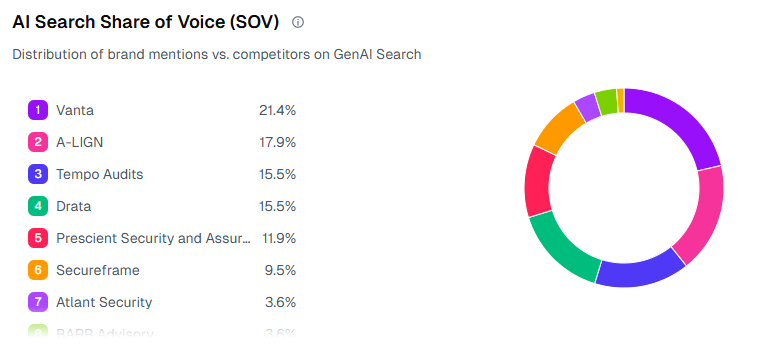
For information on GEO tools and how they make a difference in GEO performance measurement, read our article - Top GEO tools: The ultimate comparison for AI search optimisation.
Conclusion: Making your brand unforgettable to AI
Improving LLM brand entity visibility follows a clear, data-driven path. Brands must -
- Audit how AI currently sees them,
- Structure their data for clarity,
- Create authoritative prompt-focused content,
- Authorise their entity through trusted citations, and
- Measure performance to refine results over time.
These steps are not a departure from SEO best practice. Effective GEO is built on the same foundations: strong technical implementation, high-quality content, and genuine authority across the web. The difference is how these signals are interpreted by AI-driven search engines.
The opportunity is time-sensitive. Brands that invest in GEO now gain a durable advantage before AI search becomes crowded and competitive. To start building that advantage, explore how Buried supports brands at scale and contact us today!
Work with Buried
Speak to an AI search expert
Want AI models to recognise and recommend your brand? Tell us your goals and we will strengthen your entity across generative engines.
Book a call
About the author
Will Tombs
Founder, Buried
Will Tombs is the Founder of Buried. He’s an award-winning growth marketing specialist and expert in SEO and GEO. With over 12 years’ experience in industry, Will has led digital strategy for: Startups that have gone on to be acquired, international enterprise retailers, and his own e-commerce businesses.
From the blog