Large Language Models (LLMs) such as ChatGPT and Google Gemini are reshaping how people discover information online. Traditional search engines like Google remain critical, but for many informational and exploratory queries, AI-driven search provides a faster, more direct experience.
Instead of scrolling through multiple links, users can now ask questions and receive clear, combined answers from AI systems. This helps explain why the usage of AI-powered search is growing rapidly worldwide. According to recent industry data, AI-generated summaries now appear in about 50% of Google search results (Google AI Overviews), with that share expected to rise above 75% by 2028 .
What’s exciting for brands is that more people are searching than ever before. Users have the ability to ask questions to LLMs and get answers previously unattainable through Google. This shift means that content discoverability by Google and AI Engines is more important than ever, and one of the things that affects this is content architecture.
What is content architecture?
Content architecture in SEO and GEO is the strategic way content is structured, connected, and presented so it can be understood by both search engines and AI systems. This article explains some of the fundamentals of content architecture in GEOr. Fortunately, content architecture optimised for Google search shares lots of similarities with content architecture optimised for LLMs.
Also learn - How do ChatGPT and other LLMs work?
The core pillars of a GEO-ready content architecture
A strong content architecture for LLM search visibility rests on three core pillars: Technical excellence, authoritative content, and demonstrable authority.
These pillars are not new. They have long underpinned effective SEO. However, in an AI-driven search landscape, how they are applied matters far more than before. This is the focus of a specialist GEO agency approach, where architecture is designed explicitly for AI-powered search visibility, not retrofitted from traditional SEO practices.
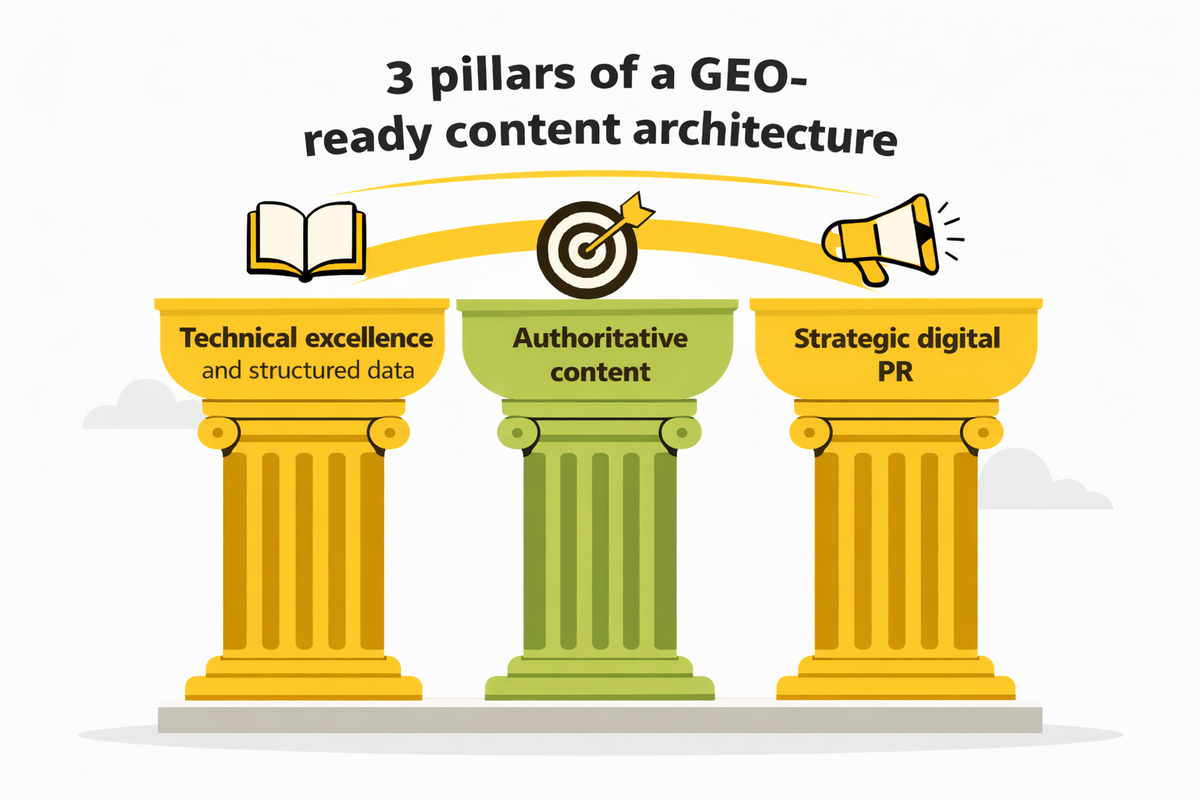
Pillar 1: Technical excellence and structured data
1. Technical foundation
LLMs, much like traditional search engines, rely on a strong technical foundation to access and interpret content accurately. If your site is difficult to read or slow to load, AI systems are far less likely to use it as a trusted source. However, GEO introduces some important technical nuances:
- Code structure - LLMs prefer clean, well-structured HTML. Many AI crawlers\ have a limited ability to execute JavaScript, which makes server-side rendering * critical for consistent visibility in LLM-powered search.
- Site speed and accessibility - Fast-loading, accessible websites are easier for AI systems to process. Content that loads quickly and cleanly is more likely to be recalled and cited in AI-generated answers.
- URL structure - Descriptive URLs provide immediate context. Clear URLs help AI models understand what a page is about without relying on surrounding signals.
Together, these elements ensure your content can be reliably accessed, parsed (analysed and structured by machines), and interpreted by generative engines.
AI crawlers are systems that read, interpret, and extract information for AI-generated search responses.
Server-side rendering delivers fully built HTML to AI crawlers, ensuring content is immediately accessible without relying on JavaScript execution.
2. The role of structured data
Structured data, often implemented using Schema, acts as a shared vocabulary between your website and AI systems. It helps LLMs understand entities, relationships, and context*, rather than guessing meaning from raw text alone. For GEO, this is mission-critical.
- Entities: identifiable people, brands, or things
- Relationships: how entities connect or interact
- Context: meaning provided by surrounding information
Implementing key Schema types such as Organization, Author, Product, FAQ, and HowTo * directly feeds the information that AI models use to construct their answers, making your content far more likely to be cited.
- Organization – clarifies who you are and builds trust
- Author – reinforces credibility and expertise
- Product – supports commercial and comparison queries
- FAQ – aligns with question-based AI retrieval
- HowTo – enables step-by-step answers in AI responses
Pillar 2: Expert-led, authoritative content
1. Content for LLMs
LLM-powered search engines prioritise content that demonstrates experience, expertise, authoritativeness, and trust (E-E-A-T). Content must answer real user questions clearly and align with natural language prompts. In practice, some of the most effective formats for GEO include:
- Comparative listicles that explain options and trade-offs
- “Top X” articles that provide clear recommendations
- In-depth guides with practical detail and regional relevance
These formats help AI systems extract structured answers while signalling authority and usefulness.
2. Extracting and showcasing expertise
Most businesses already possess deep subject-matter expertise. This invaluable knowledge often remains locked away, never making it into marketing content. A core part of our work as an SEO agency is finding this internal expertise and turning it into clear, authoritative content that positions your brand as a trusted industry resource.
Pillar 3: Building authority with digital PR
1. Why Digital PR is crucial for GEO
If content is the “what,” then authority is the “why”. Digital PR plays a central role in Generative Engine Optimisation by building the authority signals that LLMs rely on when selecting sources. AI engines assess brand mentions, citations, and references from trusted publications to validate accuracy and credibility. Brands consistently mentioned by authoritative sources are far more likely to be recommended within AI-generated answers.
2. Strategic digital PR for AI visibility
Effective digital PR campaigns secure high-quality backlinks and credible media coverage. These signals create a clear, verifiable trail of validation that LLMs can follow, thus increasing the likelihood of being cited. As a specialist digital PR agency, we design campaigns specifically to build these trust signals for both search engines and AI.
A step-by-step guide to implementing a GEO content architecture
Step 1: Conduct a comprehensive GEO audit
Audit process
The first step in building a GEO-ready content architecture is understanding how your brand currently performs across generative engines. Unlike traditional SEO audits, a GEO audit focuses on how AI systems perceive, interpret, and reference your content. Key areas to assess include:
- Entity visibility and sentiment* across AI-generated answers
- Citation frequency and which sources AI engines reference
- Schema coverage* and the quality of structured data implementation
- Authority signals, including backlinks*, brand mentions, and media coverage
Sentiment measures whether AI presents your brand positively, neutrally, or negatively.
Schema coverage shows how much of your content is clearly defined using structured data.
Backlinks are links from other websites that signal trust, authority, and credibility.
This analysis provides a clear picture of how visible and credible your brand is within LLM-powered search.
Identify gaps and opportunities
A GEO audit highlights where visibility is weak, where trust signals are missing, and where competitors are being cited instead. These insights reveal immediate opportunities and risks, forming the foundation of a focused GEO strategy designed to improve LLM search visibility.
Step 2: Develop an integrated content and digital PR strategy
Once the audit is complete, the next step is building a clear roadmap that aligns content creation, technical optimisation, and Digital PR. This involves identifying topic clusters where your brand can realistically establish authority and producing content that answers likely user prompts directly. Digital PR campaigns should then support this content by earning relevant links and brand mentions from high-authority publications, helping AI systems validate and recommend your brand. This integrated approach sits at the core of Buried’s wider services offering.
Step 3: Track and measure GEO performance
Define GEO metrics
GEO requires a different measurement framework from traditional SEO. Instead of focusing on rankings and clicks alone, performance is measured by how often and how accurately AI systems reference your brand. Key metrics include:
- Brand mentions across LLMs,
- Citation frequency and quality,
- Prompt-level visibility and share of voice,
- Sentiment and accuracy of mentions, and
- Referral traffic from AI-powered search engines.
Utilise GEO tools
GEO tools are now emerging to track these signals. Platforms such as Athena, Peec AI, and similar tools enable prompt tracking, citation analysis, and competitor benchmarking within AI search.
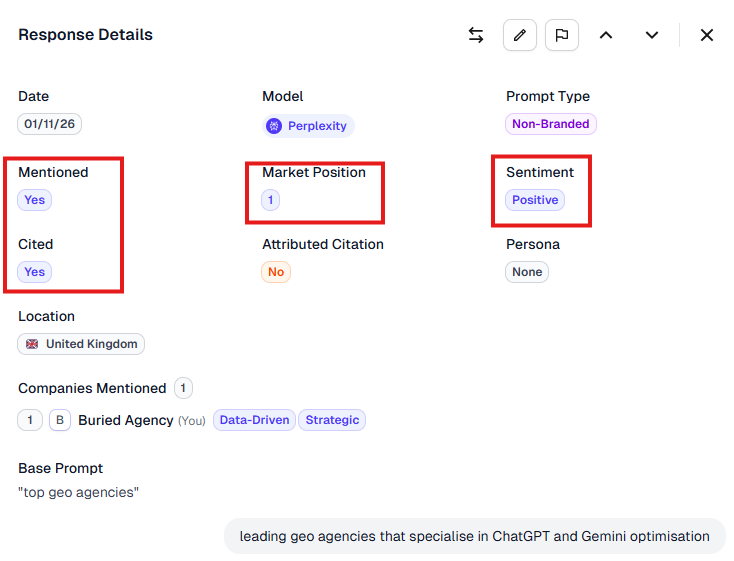
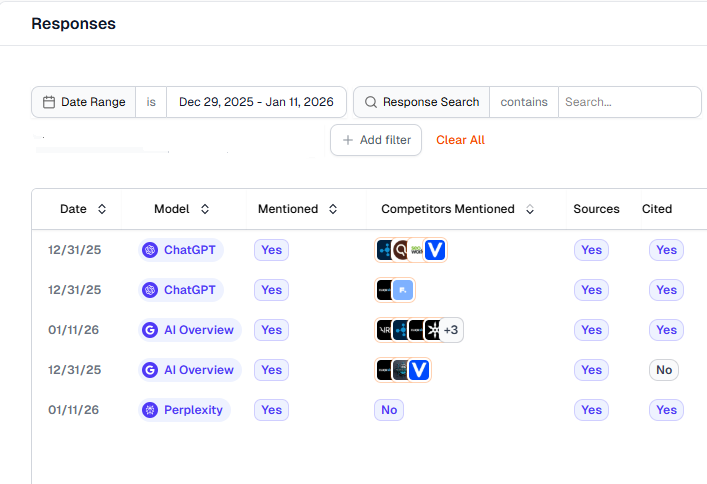
A deeper comparison of available platforms is covered in our article Best GEO Tools in 2025: The Ultimate Comparison for AI Search Optimisation.
The symbiotic relationship: How SEO, GEO, and digital PR work together
It is crucial to understand that GEO does not replace SEO; it builds upon it. The two disciplines are deeply symbiotic, sharing the same foundations of high-quality content, technical excellence, and strong authority. A robust SEO foundation is an absolute prerequisite for any effective GEO strategy.
This table clarifies their distinct-but-related functions:
| Area | GEO (Generative Engine Optimisation) | SEO (Search Engine Optimisation) |
|---|---|---|
| Primary goal | Optimise for inclusion, citation, and recommendation in AI answers. | Optimise for high rankings in search engine results pages (SERPs). |
| Content focus | In-depth, expert-led content answering natural language prompts. Comparative listicles and regional content perform well. | Content optimised for specific keywords and user intent. Service pages and blogs are common. |
| Technical focus | Clean HTML is critical, as LLMs struggle with JavaScript. Structured data (Schema) directly supports AI citations. | Crawlability and indexability are key. Site speed and Core Web Vitals (Google metrics measuring page experience performance) influence rankings. |
| Authority signal | Relies on trusted citations, brand mentions, and strong entity authority. | Relies on high-quality backlinks from relevant websites to build authority. |
An effective organic growth strategy today requires integration, not separation. Digital PR builds authority that strengthens both SEO rankings and GEO citations. At the same time, a unified content architecture ensures your content serves human users while remaining clear, trustworthy, and reusable for AI models driving modern search.
Related read - GEO vs SEO: What’s the difference, and what should you do about it?
Conclusion: Build a future-proof architecture for discoverability
Designing a content architecture for LLM search visibility is not a separate discipline. It is the natural evolution of proven SEO and Digital PR best practices, adapted for how AI systems now discover and recommend information. Brands that invest in expert-led, well-structured content and build genuine authority through credible third-party signals are best positioned to perform across both traditional search results and AI-generated answers. These signals help search engines and LLMs trust, interpret, and reuse content accurately.
Now is the time to adapt your content architecture and build a future-proof foundation for organic discoverability. To explore how this integrated approach works in practice, contact Buried today!
Work with Buried
Speak to an AI search expert
Want your content architecture built for AI-powered search from the ground up? Tell us your goals and we will design a GEO-ready structure across content, schema, and Digital PR.
Book a call
About the author
Will Tombs
Founder, Buried
Will Tombs is the Founder of Buried. He’s an award-winning growth marketing specialist and expert in SEO and GEO. With over 12 years’ experience in industry, Will has led digital strategy for: Startups that have gone on to be acquired, international enterprise retailers, and his own e-commerce businesses.