Online search is changing fast. For certain searches, people are moving away from Google and asking questions inside platforms like ChatGPT, Perplexity, and Claude to receive direct, conversational answers.
For businesses, this creates a new challenge. It is no longer enough to rank on page one of Google. You need to be cited (used as a trusted source in an AI-generated answer), referenced, and recommended inside AI-generated responses.
This is where LLM retrieval mapping matters. It is the process of understanding how Large Language Models find information, judge relevance, and pull content from across the web to form answers.
When you understand this process, you can stop guessing. And you can build data-driven GEO strategies that improve how AI systems see and use your brand. This approach sits at the core of modern GEO services and defines how visibility works in AI search.
What is LLM retrieval mapping?
LLM Retrieval Mapping is a framework used to understand how AI search engines work - and then apply those insights to marketing strategy.
It helps brands see why AI platforms choose certain sources and how they build answers.
The concept has two simple parts.
- LLM retrieval is how an AI model gathers information from external sources when someone asks a question. Instead of relying only on its training data*, it pulls in relevant web content to shape a response.
- Mapping is the strategic layer. It analyses which sources are retrieved, how often they appear, and what type of content AI prefers. This reveals gaps, patterns, and clear opportunities for a brand to become a trusted reference.
This entire process is powered by Retrieval-Augmented Generation (RAG), the system that allows AI to combine live information with language generation.
*Training data is the large collection of text, images, and information used to teach an AI model how language and facts work.
The foundation: Understanding Retrieval-Augmented Generation (RAG)
Retrieval-Augmented Generation (RAG) is a method that allows AI models to check external, trusted sources before answering a question. Instead of relying only on what it already knows, the AI looks up fresh and relevant information to shape its response.
A simple way to think about RAG is an open-book exam. The AI is allowed to consult reference material before answering, which improves accuracy and relevance.
This approach helps fix common AI issues. It prevents the AI from providing outdated information and limits hallucination. RAG reduces these risks by grounding answers in real, up-to-date sources.
Studies show that RAG can reduce AI hallucinations by up to 30% (Dataversity) and can achieve up to 50% higher relevance.
Perhaps the most commercially significant benefit for brands is that RAG enables LLMs to cite their sources. This transparency not only allows users to verify information but also creates the very mechanism through which your brand can be mentioned and linked. This turns visibility directly into customer conversions.
Related read - How do ChatGPT and other LLMs work?
How LLM retrieval works in practice: From prompt to answer
To understand how brands appear in AI answers, it helps to see how an AI search query actually works. The process follows a clear journey from question to response.
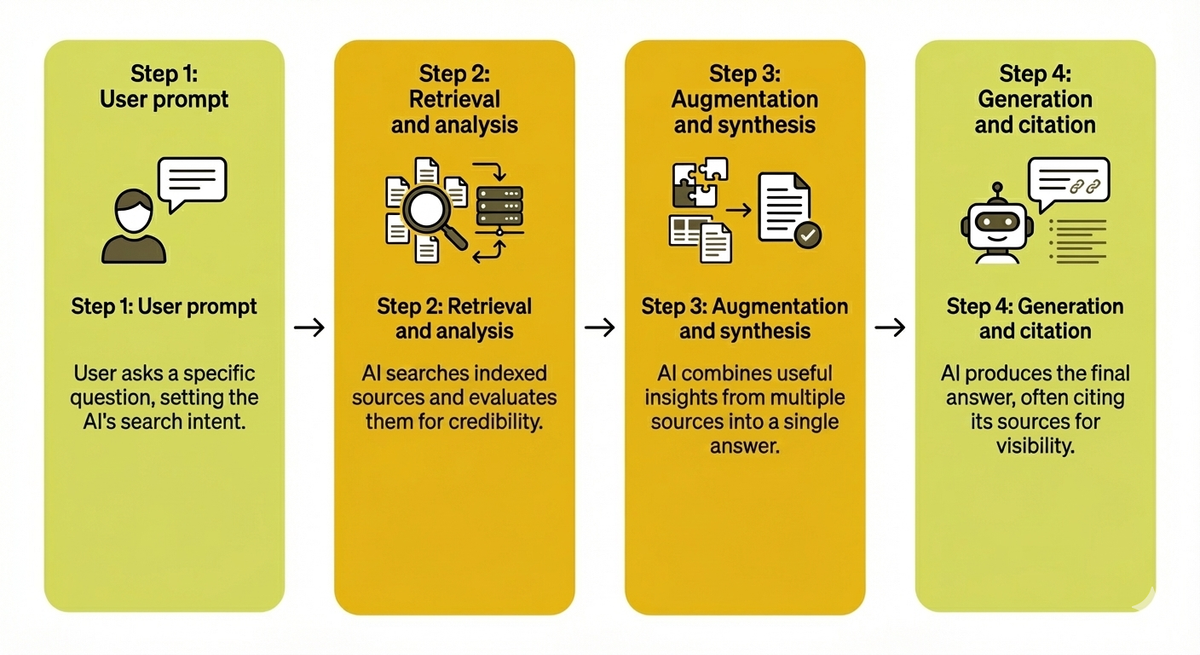
Step 1: User prompt
A user asks a specific question, such as: “What are the best eco-friendly cleaning products available in the UK?”
This prompt sets the intent and context for the AI’s search.
Step 2: Retrieval and analysis
The AI interprets the question and looks for relevant information across its indexed sources*. These may include web pages, articles, and trusted databases.
*Indexed sources are web pages, documents, and data that AI systems have already stored, organised, and can quickly retrieve when answering questions.
Sources are evaluated based on signals like clarity, credibility (being trusted and reliable), authority (recognised expertise and influence), and how well the content answers the question.
Step 3: Augmentation and synthesis
The AI then pulls the most useful insights from multiple sources. It combines them into a single, clear answer rather than repeating one page word by word.
This is where structured, authoritative brand content gains an advantage.
Step 4: Generation and citation
The AI produces the final response and may cite the sources it relied on. This is the point where brands gain visibility through mentions and links inside AI-generated answers.
Google’s geospatial AI is a clear example of how LLM retrieval works in practice.
When a user asks a complex question involving location, such as climate risk, transport planning, or regional trends, Google’s AI does not rely on one source. It pulls data from maps, satellite imagery, research papers, and trusted datasets.
The AI then combines this information to produce a single, clear answer that explains what is happening and why, rather than listing links.
This mirrors how AI search retrieves, evaluates, and combines multiple sources to deliver one authoritative response.
From retrieval to mapping: Building a data-driven GEO strategy
Understanding how AI retrieves information is only the first step. The real strategic value comes from mapping what those models choose to show in their answers.
Mapping analyses AI outputs to see which brands are mentioned, which sources are cited, and what content formats appear most often. This creates a clear roadmap for improving visibility inside AI-generated responses.
Instead of guessing what might work, brands can focus on the topics, questions, and formats AI already trusts.
This approach sits at the heart of an effective organic search strategy in the age of AI.
The core pillars for LLM retrieval
For an AI system to retrieve and cite your website, the foundations must be strong.
The core pillars are non-negotiable and, fortunately, align perfectly with best-practice SEO.
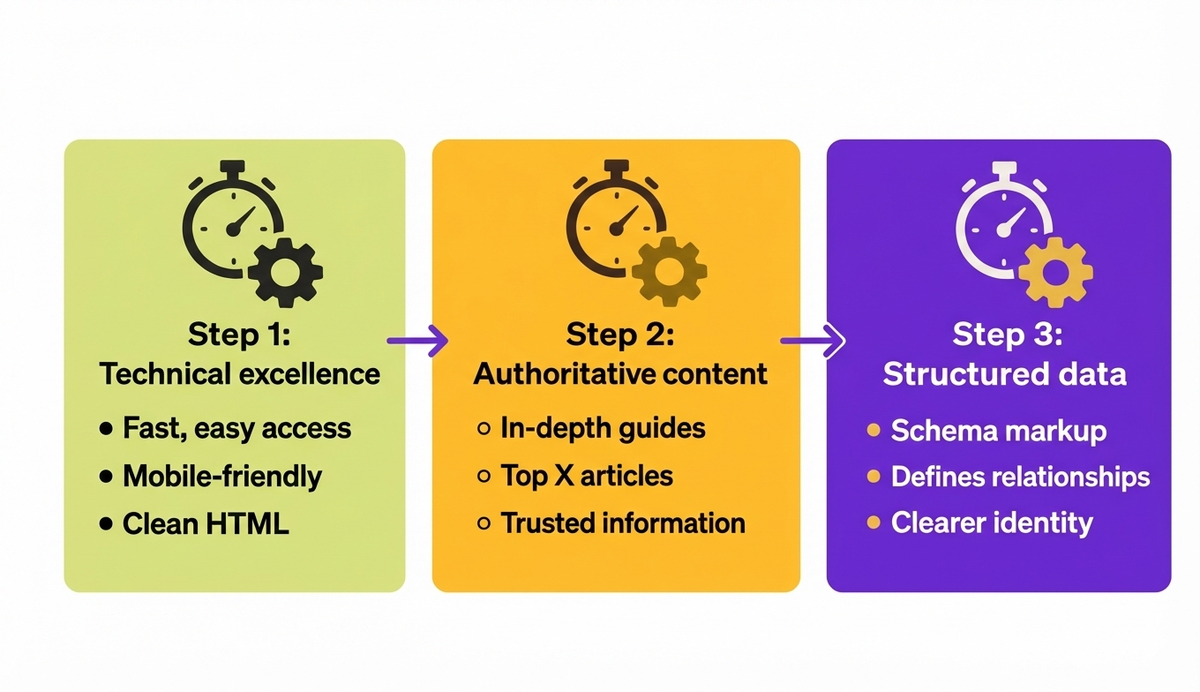
Technical excellence
Your site must be easy to access and understand.
Fast loading speeds, mobile-friendly layouts, and clean HTML matter. AI systems struggle with heavy JavaScript, so simple, well-built pages perform better.
Authoritative content
LLMs favour content that shows real expertise and trust.
Clear guides, in-depth explainers, and comparison pieces like “Top X” lists are often prioritised because they answer questions directly and confidently.
Structured data
Schema markup helps AI clearly understand who you are, what you offer, and how your services connect. This makes it easier for LLMs to reference your brand accurately within answers.
These pillars reinforce why strong SEO foundations remain essential for long-term GEO success. Buried’s data-driven approach to organic search optimisation is powered by an integrated GEO and SEO services strategy tailored for every business.
Also learn - GEO vs SEO: What’s the difference and what should you do about it?
Using mapping to find gaps and opportunities
LLM mapping starts by reviewing AI-generated answers for your most important search prompts. This shows which brands are mentioned, which sources are cited, and how answers are structured.
By analysing these results, you can spot clear gaps. You may find competitors are cited because they publish detailed reviews, comparison tables, or clearer explanations that better match user intent.
To do this at scale, specialised GEO tools are essential. They track prompt visibility, citation frequency, and competitive share of voice across AI platforms. This data removes guesswork and highlights where to focus next.
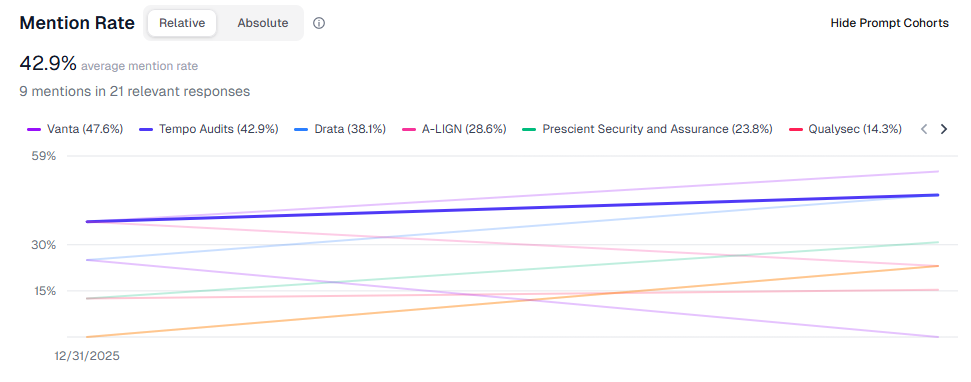
Image 1 - Buried client Tempo Audits brand visibility measured against competitors on AI models like ChatGPT and Perplexity on the GEO tool.
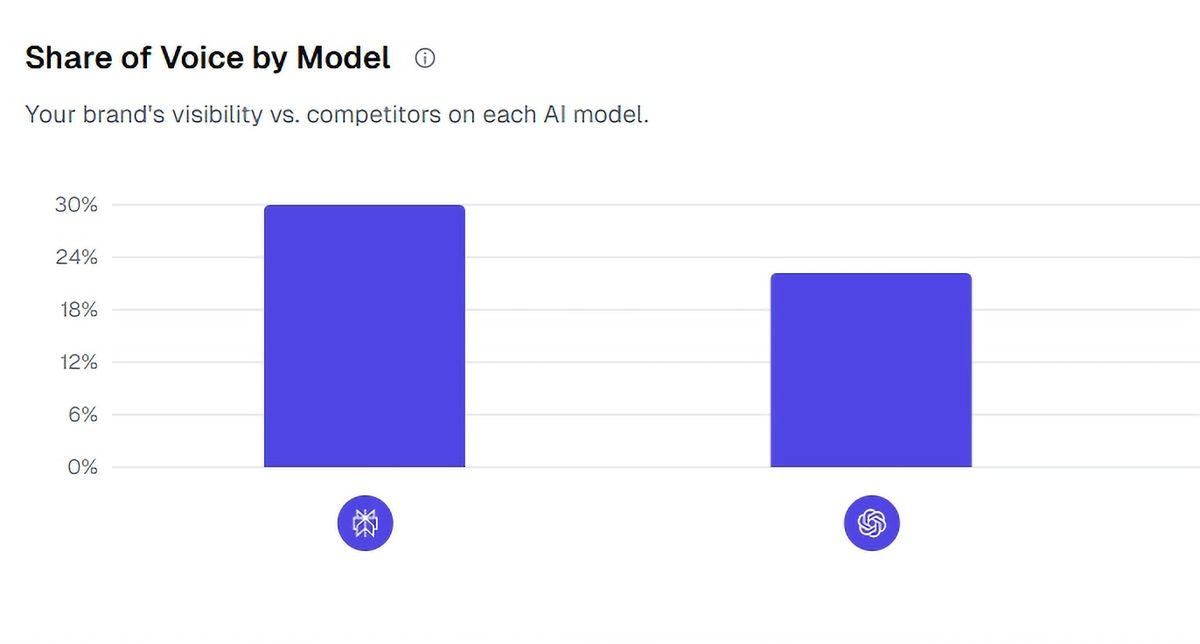
Image 2 - Buried client Tempo Audits mention rate analysis against competitors on the GEO tool.
For a deeper look at the technology involved, see our guide to the best GEO tools.
Putting it all together: Your LLM retrieval mapping action plan
LLM retrieval mapping is not a one-off task. It is a structured process that combines research, analysis, and strategy.
For most businesses, this depth requires expertise and the right tools.
Why LLM retrieval mapping requires a specialist GEO agency
The principles behind LLM retrieval mapping may be easy to grasp. Executing them well is not. Turning AI behaviour into consistent brand visibility requires specialist knowledge and experience.
Effective GEO goes beyond “AI SEO”. It demands a deep understanding of how LLMs retrieve information, evaluate sources, and decide which brands to cite within answers.
This is where Buried stands apart. As a specialist GEO agency, Buried focuses on the structural work that drives AI visibility, not surface-level optimisation. We combine advanced technical SEO, data-driven content strategy, and authority building to increase your eligibility and measurable likelihood of being cited.
To explore expert-led GEO in more detail, visit the Buried website and see how data-driven GEO strategies are built for the AI search era.
Ready to turn visibility into revenue? Let’s talk.
Work with Buried
Speak to an AI search expert
Tell us your goals and we will build the SEO and GEO strategy to reach them.
Book a call
About the author
Will Tombs
Founder, Buried
Will Tombs is the Founder of Buried. He’s an award-winning growth marketing specialist and expert in SEO and GEO. With over 12 years’ experience in industry, Will has led digital strategy for: Startups that have gone on to be acquired, international enterprise retailers, and his own e-commerce businesses.
From the blog
Related Posts
GEO vs SEO - What's the difference and what should you do about it?
Where the two overlap, where they split, and how to run both.
Will TombsRead →What is link building in SEO & GEO?
Why authoritative mentions still move the needle in both.
Will TombsRead →Top GEO agencies UK
How the leading agencies compare on AI search expertise.
Will TombsRead →