Contents
The way people find information online is changing. For years, success meant getting to the top of Google’s search results. But now, customers are increasingly asking questions to Large Language Models (LLMs) like ChatGPT, Gemini, Perplexity, and Google’s AI Mode and getting instant, detailed answers.
In this new world, your brand’s survival depends not on Google rankings but on being mentioned as a trusted source in LLMs.
This article explains why brand mention optimisation matters for LLM search. You’ll get a clear, data-driven playbook to increase visibility across platforms like ChatGPT, Gemini, Perplexity, Google AI Overviews, and other LLMs, and reduce the risk of brand misrepresentation in AI results.
The new search frontier: Why Generative Engine Optimisation (GEO) matters
Consumer behaviour has shifted. People now ask AI tools for advice, comparisons, and recommendations at the very start of their online search journey.
Discovery is moving away from blue links to AI-generated answers.
Elementor highlights that around 80% of consumers use AI summaries for at least 40% of their searches online.
This is where Generative Engine Optimisation (GEO) comes in. Put simply, GEO is the process of making your brand’s content and online presence easy for AI to find, understand, and recommend. If your brand is not recognised or contextually understood, you risk becoming invisible in AI search.
As a specialist GEO agency, we help businesses adapt in this new landscape with a practical and data-based approach to GEO.
Brand mentions: The currency of trust in the age of AI
Think of brand mentions as the new currency for building trust with AI.
LLMs learn by processing huge amounts of information from the internet. When they repeatedly see your brand mentioned on authoritative and relevant websites, they start to recognise you as an expert in your field.
These mentions help AI models connect your brand to specific topics, products, or services. In fact, research by Ahrefs shows that brand mentions ensure increased visibility across all AI platforms.
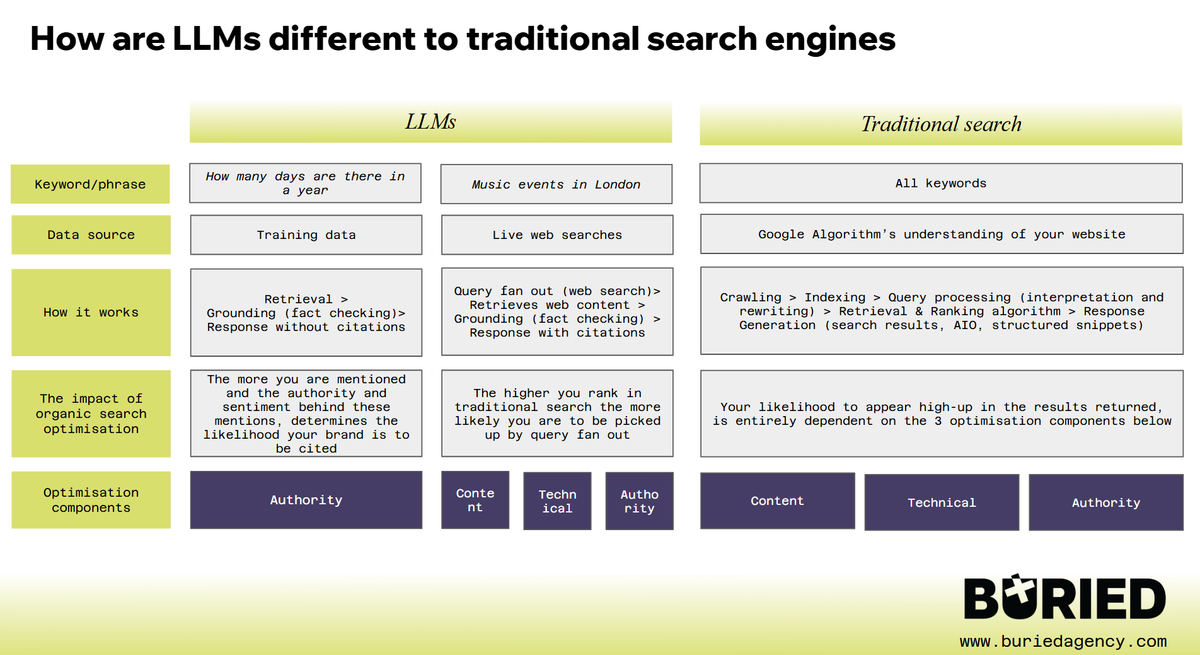
This is a big change from traditional SEO, where backlinks (direct links to your site) were the main signal of authority. In the world of GEO, the mention itself, even without a link, carries significant weight. Take a look at how LLMs differ from traditional search engines for a better understanding of the difference between GEO and SEO.
A 4-pillar framework for brand mention optimisation
To systematically increase the chances of your brand being mentioned, you need a clear strategy.
This framework forms the core of an effective LLM search strategy. Each pillar focuses on helping AI systems find, understand, trust, and mention your brand in generated answers.

Pillar 1: Develop authoritative, expert-led content (E-E-A-T)
The starting point for any strong GEO strategy is high-quality content built on Experience, Expertise, Authoritativeness, and Trustworthiness (E-E-A-T).
E-E-A-T is a Google search quality framework, created to help assess content credibility in organic search. Content optimised for SEO is expected to meet these standards.
The same approach is equally effective for GEO. AI systems prioritise sources that clearly demonstrate real expertise and subject-matter authority.
You can turn your team’s internal knowledge into content that both search engines and LLMs favour, such as:
- Comparative listicles (“The 5 Best Project Management Tools for Agencies”)
- Comprehensive guides (“A Beginner’s Guide to Investing in 2026”)
- “Top X” articles that rank products or services in your industry.
This expert-led content is the foundation of a powerful, combined SEO and GEO strategy.
Pillar 2: Structure your website for machine readability
AI needs clarity. If your site is messy, your brand is harder to understand.
Your website and online information must be organised in a way that is easy for computer programs to read. Focus on:
- Clean page structure and headings
- Clear service and product definitions
- Advanced schema and structured data
Schema and other forms of structured data are basically a type of code that adds labels to your content, telling AI engines exactly what each piece of information is. For example, “this is a product,” “this is our company name,” or “this is a customer review.”
Creating a “model-friendly” architecture like this ensures your content is clean, organised, and ready for AI to process.
Pillar 3: Secure high-value citations with digital PR
What others say about you online is a powerful signal of credibility. An AI model needs to see that other trusted sources vouch for your expertise.
A modern digital PR strategy should focus on getting your brand mentioned in reputable online publications, industry news sites, and journals. These mentions act as third-party verification, proving to the AI that your brand is a legitimate authority in its field.
This is a core part of authority building that underpins all successful organic search campaigns.
Related read - The role of digital PR in Generative Engine Optimisation (GEO)
Pillar 4: Align content with conversational prompts
AI search is conversational, not keyword-based. Similarly, queries are longer, more specific, and framed as questions.
For example:
- “What is the best option for…”
- “How does X compare to Y for small businesses?”
To get your brand mentioned in the answer, you need to research the specific questions your target audience is asking. From there, you can create targeted content that directly answers those long-tail prompts. This helps position your brand as the most helpful resource.
Measuring what matters: Tracking your brand’s performance in LLMs
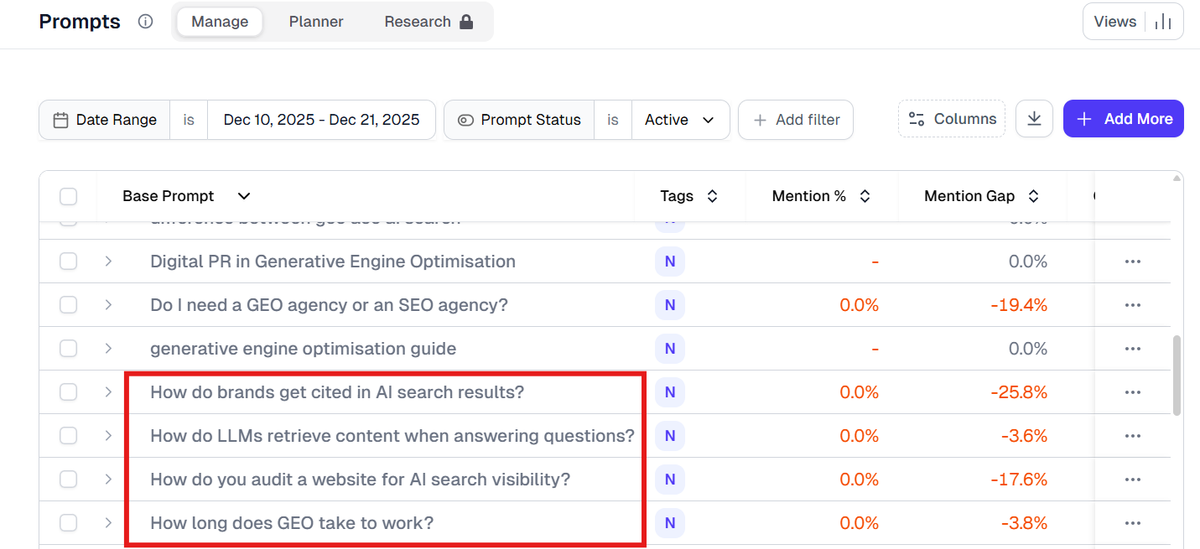
A data-driven strategy requires measurement. To know if your GEO efforts are working, you need to track a new set of metrics that go beyond traditional SEO analytics.
This calls for a dedicated reporting framework designed for the AI search environment.
The Key Performance Indicators (KPIs) for GEO
To measure the success of your brand mention optimisation, you should track these key metrics:
- Conversions from AI-driven search: How many users convert to leads or purchases from AI search.
- Brand mention frequency: How often your brand is mentioned across different LLMs.
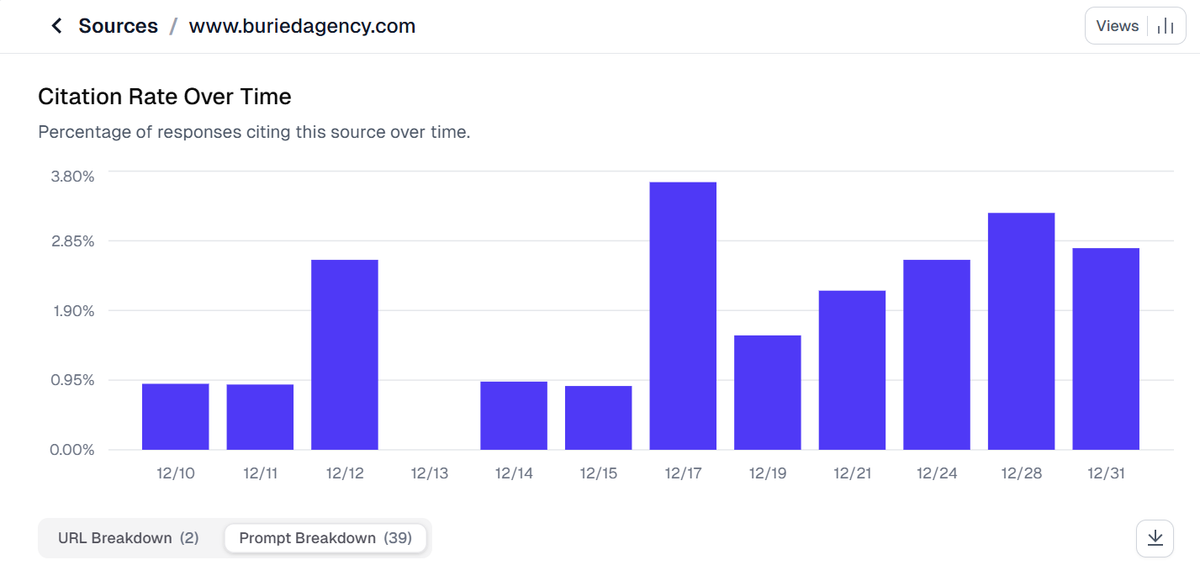
- Citation frequency: How often an AI cites your website as a source for its answer.
- Visibility for specific user prompts: Your brand’s share of voice for important customer questions.
- Sentiment analysis: Whether your brand is being mentioned in a positive, neutral, or negative way.
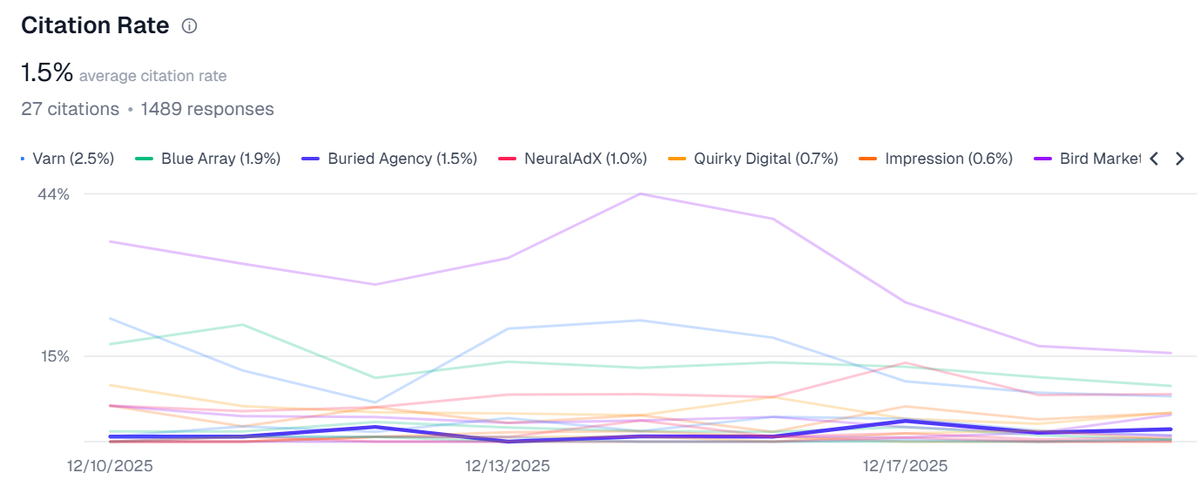
- Competitive share of voice: How your visibility in AI answers compares to your competitors.
- Referral traffic and conversions: How much traffic and how many leads are coming from AI search platforms.
Related read - GEO performance metrics: Top 5 AI-search KPIs every marketer must track
Building your GEO reporting stack
Tracking these new KPIs requires a modern set of tools. At Buried, we use a specialised reporting stack that combines AI monitoring tools like Peec AI and Athena with Google Analytics 4 to get a full picture of performance.
This cost-focused and data-driven approach allows us to pinpoint exactly what is working and make targeted adjustments to continuously improve our clients’ visibility and conversions.
Learn about the top GEO tools for efficient AI search optimisation.
Conclusion: Secure your brand’s future in AI search
Dominating LLM search requires a proactive, data-driven approach. Brand mentions are now the strongest signal of trust in AI answers. To earn them, brands must focus on authority, clarity, and consistency across the web.
A strong SEO foundation still matters. But GEO needs specialist expertise to make your brand visible, trusted, and citable in AI systems.
Adopting GEO now is essential to protect your future growth and take advantage of the biggest shift in search this millennium.
If you are ready to unearth discoverability and grow conversions in the age of AI, contact our team of organic search experts to see how we can help. Read more: The top GEO agencies in the UK
Work with Buried
Speak to an AI search expert
Our team is ready to make your brand visible, trusted, and cited across AI search. Tell us your goals and we will map the GEO strategy to reach them.
Book a call
About the author
Will Tombs
Founder, Buried
Will Tombs is the Founder of Buried. He’s an award-winning growth marketing specialist and expert in SEO and GEO. With over 12 years’ experience in industry, Will has led digital strategy for: Startups that have gone on to be acquired, international enterprise retailers, and his own e-commerce businesses.
From the blog
Related Posts
The role of digital PR in Generative Engine Optimisation
How third-party mentions and coverage build the authority AI models trust.
Will TombsRead →Top 5 AI-search KPIs every marketer must track
The metrics that show whether your brand is winning in AI answers.
Will TombsRead →GEO vs SEO - What's the difference and what should you do about it?
Where the two overlap, where they split, and how to run both.
Will TombsRead →