For years, strategy in organic search has been built around publicly available, location-specific keyword data. We knew what people searched for on Google, and we built our campaigns around it. That’s all changing.
The rise of generative AI engines like ChatGPT and Gemini has created a big visibility problem. Your content is being cited and used to generate answers, but you have no reliable way to track when, why, or how it’s happening.
Tracking AI visibility, and prompts specifically, is where most brands are getting stuck.
Related read: How do ChatGPT and other LLMs work?
Video: How to do prompt research
If you don’t fancy a read, then watch the video version of this article through the player below.
Why is prompt research so difficult?
The shift from keywords to prompts creates a new challenge for every business. The process is fundamentally more difficult than traditional keyword research for two critical reasons:
- Data is unavailable: Google makes location-specific keyword data publicly available. Data for AI search platforms (like ChatGPT or Gemini) is currently zero. We are effectively blind to what our audience is asking.
- Infinite variation: Keywords are generally short (1–5 words). AI prompts use conversational, long-form language, resulting in an almost infinite number of variations. This explodes the tracking universe.
| Keywords in Google | Prompts in LLMs | |
|---|---|---|
| Search volume data availability | Publicly available from Google by location | Universally unavailable from all platforms |
| Search length | Primarily 1-5 words | No limit - long form conversational |
| Example | best project management software | What is the best project management software for a 10-person UK agency that handles client work, needs time tracking, and integrates with Slack? |
Why is prompt research important?
Prompt research is the foundation of Generative Engine Optimisation (GEO). Without it, you are tracking nothing.
- Measure impact: You cannot track your true impact in AI search if you don’t know the prompts your audience is actually using.
- Audit foundation: It is the necessary starting point for any AI search audit or setting up basic reporting.
- Inform strategy: Understanding these conversational queries is how brands align their content to appear in AI-generated answers and citations.
The Buried Framework provides the structured logic to identify, prioritise, and track the prompts that genuinely matter to your brand’s visibility.
Related read: What is a GEO audit?
The Buried framework for prompt research
This framework is the structured logic for tracking the prompts that deliver real commercial visibility, moving past the limitations of traditional keyword research.
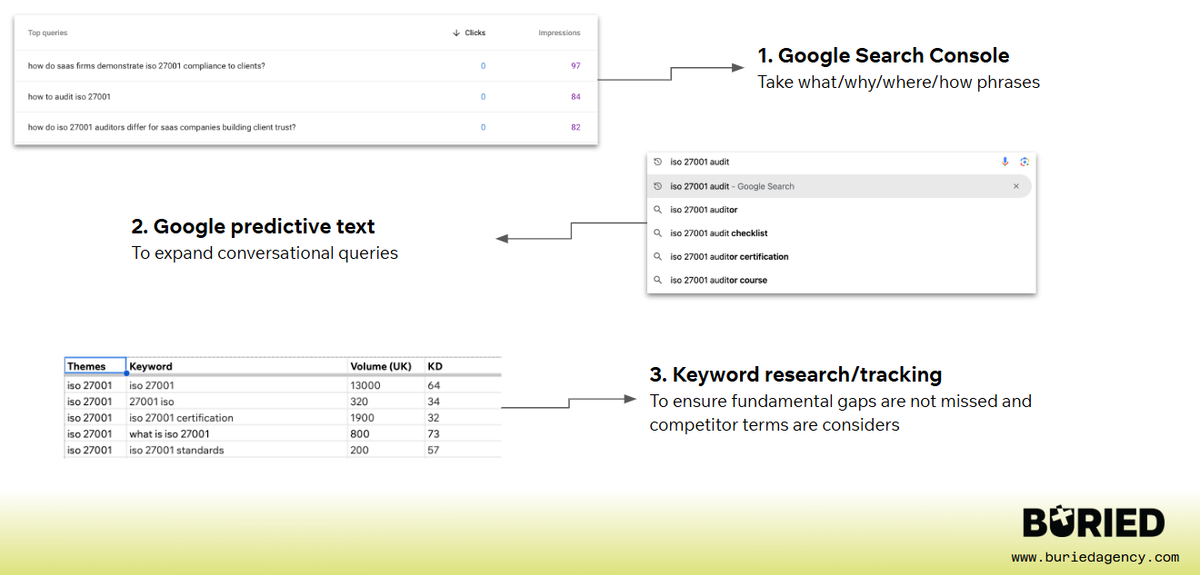
Step 1: Aggregate prompt ideas
Collect a core list of prompt ideas focusing on longer conversational queries where possible. Ensure you are covering your key service areas across a mix of informational and transactional queries.
- Google Search Console: Filter existing data for “what,” “why,” “where,” and “how” phrases to capture conversational queries.
- Google predictive text: Use core topics to quickly expand your initial question list.
- Existing keyword data: Integrate your current high-value keywords and tracking data.
Step 2: Use tools to estimate volumes and get prompt suggestions
Download your prompt ideas list as CSV and upload to your GEO tool (we use Peec and Athena).
This should give you estimated volumes and prompt suggestions:
- Estimate volume: Use the volume estimations to find correlations between high and low search demand, but use these carefully. GEO tool volumes should be used as an indicator only, as each uses its own first-party data and methods to track.
You will find variance from tool to tool when estimating volumes. For example, Peec shows a 5/5 volume estimation score for ‘how to audit soc2’, and Athena shows 100, the lowest possible score it can provide. This shows prompt volume estimations should be used to guide and inform your prompt research rather than direct it.
- Suggestions: Most tools provide prompt suggestions based on an initial prompt list you give it. Use tool-generated suggestions to fill obvious gaps in your prompt list, not to lead your entire research strategy.
Since prompt tracking is expensive, this step is critical to help prioritisation. Tracking every single prompt idea you have will get very expensive very quickly.

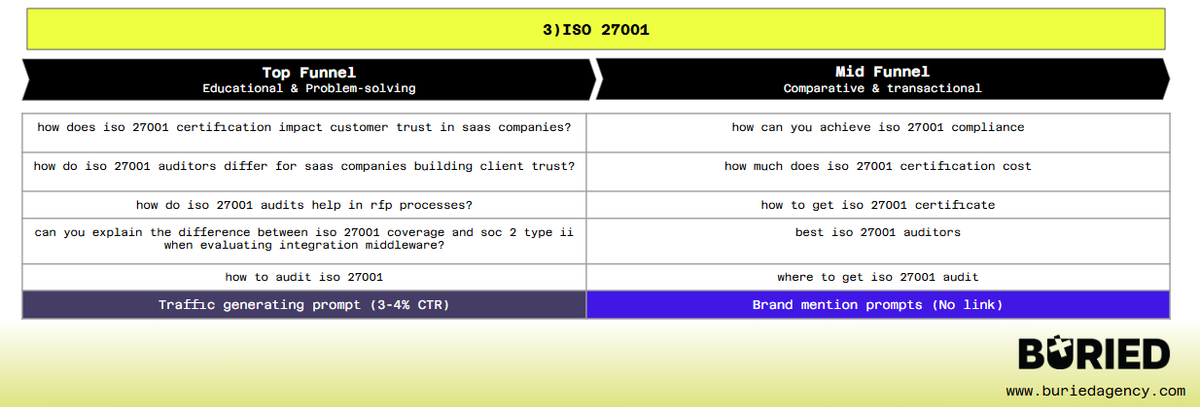
Step 3: Map prompts to the funnel
Organise your final selection into core themes and funnel stages. This provides the context for reporting ROI. Aim for a focused list of 10–20 prompts per theme.
- Top-Funnel: Prompts designed to generate traffic and citations (e.g., “How does ISO27001 impact trust?”).
- Mid-Funnel: Prompts focused on commercial intent and brand mentions (e.g., “Best ISO27001 auditors”).
Step 4: Add to GEO reporting
Upload the final, prioritised selection into your reporting tool. Use groups and tags (by theme and funnel stage) to ensure your reporting is clean, filterable, and directly shows commercial impact.
Related read: GEO performance metrics: Top 5 AI-search KPIs every marketer must track
Closing advice on prompt tracking
- Start today: It’s OK if you don’t cover absolutely everything on first go; it’s better to start tracking and iterate over time.
- Prioritise heavily: Prompt tracking can be costly, so focus on the most impactful variants.
- Use data as indicators: Treat volume estimations as indicators rather than absolute truths due to the variance between current tools.
Work with Buried
Scale your brand’s growth with GEO
For personalised insights on prompt tracking and to scale your growth with GEO, contact Buried today.
Book a call
About the author
Will Tombs
Founder, Buried
Will Tombs is the Founder of Buried. He’s an award-winning growth marketing specialist and expert in SEO and GEO. With over 12 years’ experience in industry, Will has led digital strategy for startups that have gone on to be acquired, international enterprise retailers, and his own e-commerce businesses.
From the blog
Related Posts
GEO performance metrics: The ultimate guide to AI search KPIs
The metrics that show whether your brand is winning in AI search.
Will TombsRead →Top 12 GEO (Generative Engine Optimisation) agencies in the UK
Who's doing the strongest generative-engine work, and how to choose.
Will TombsRead →GEO vs SEO - What's the difference and what should you do about it?
Where the two overlap, where they split, and how to run both.
Will TombsRead →