Key takeaways
- Technical SEO matters less than it used to. AI can now find and fix most issues, so a basic understanding is enough for most businesses, with ecommerce the main exception.
- Content has always driven SEO, and expert-led content is now what gets a business found in both Google and AI answers.
- For SEO teams, this means less time on technical fixes and more on real marketing, while technical audits should be simpler, quicker and much cheaper than before.
Technical SEO is the behind-the-scenes work that helps search engines and AI tools crawl, understand and index your website. For years, it was one of the most valuable skills an SEO could have. That’s changing fast.
It’s getting less and less important, and at some point, it’s not going to be worth very much. You just need a basic understanding. And the systems around you should manage it nearly entirely for you.
The reason is simple: AI is now so good at it.
So, what does that mean for SEO teams, and where should their time go instead? Here’s our view.
Why technical SEO used to matter before AI
Before AI agents existed, technical SEO was one of the most important parts of the job. If search engines couldn’t crawl, understand and index your site, nothing else you did would rank, however good your content was.
Getting it right was hard work. You needed really solid reporting and a good understanding of what technical SEO is and how it impacts a site. Issues were found by hand, through crawls, spreadsheets and long audits. Fixing them often meant waiting on developers.
That’s why it became a core type of SEO and a specialist skill in its own right, one that took up a lot of an SEO’s time.
Then AI arrived, and the work changed completely.
AI can now find and fix technical SEO issues
AI can now crawl a site for issues, identify them and suggest fixes really, really easily. More importantly, it can also fix them. If your CMS and website code are connected to the AI that’s finding the problems, it can fix them instantly. That’s what SEO automation looks like now.
What this looks like in practice
Here are two recent examples from our own work.
1. A full schema review, without the manual work
- The task: Review the schema across all the key page templates on a Shopify site.
- What AI did: Claude came back with a detailed review covering 10-15 points.
- The result: Every point was correct. A couple of years ago, this would have taken an SEO several hours, possibly a day.
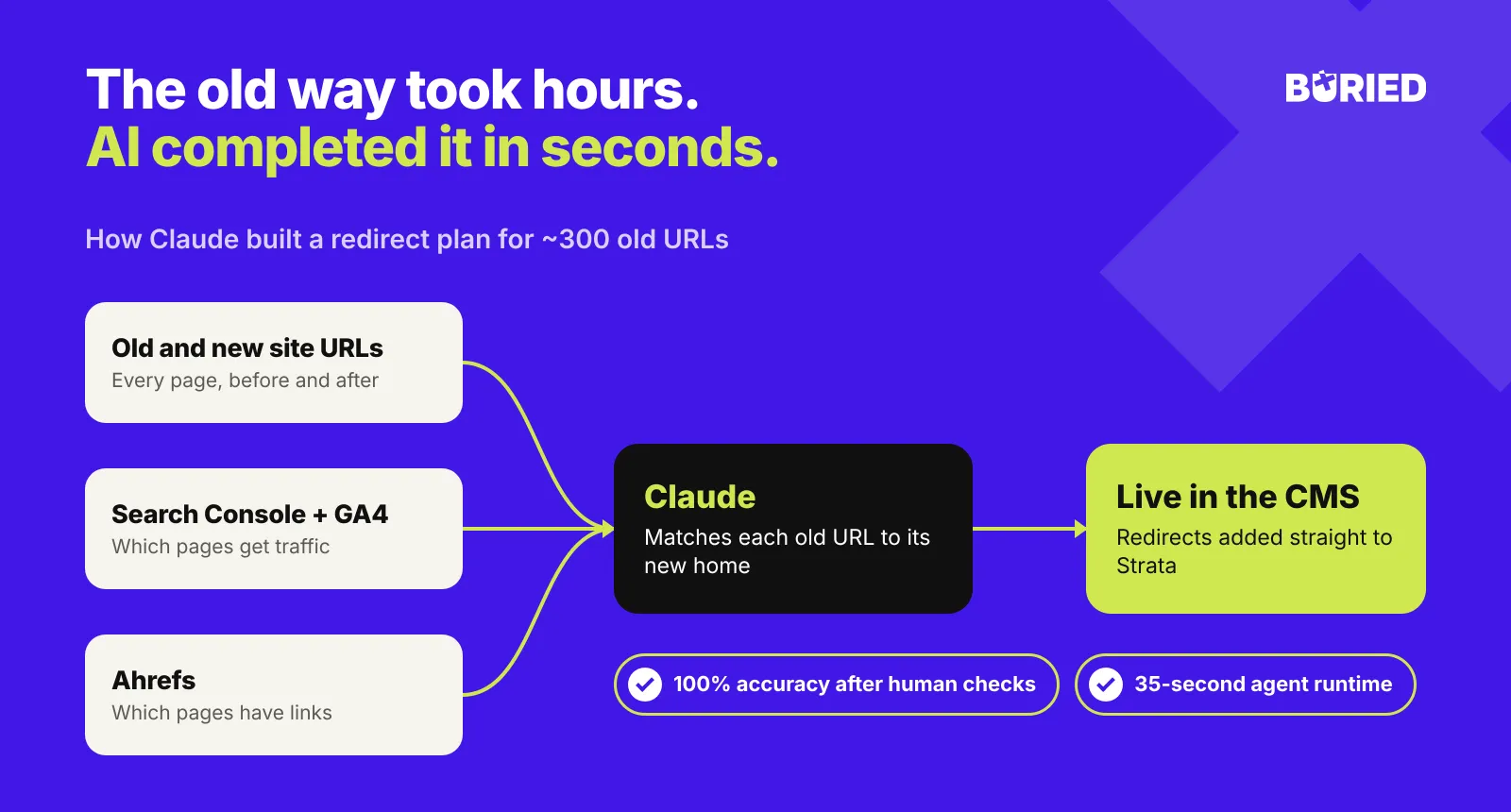
2. A 300-URL redirect plan, built and launched by AI
- The task: Move a client with about 300 old URLs and a lot of traffic onto Strata, the CMS we built at Buried, so AI can make changes like this directly.
- What AI did: Claude compared the old and new URLs, checked Search Console, Google Analytics and Ahrefs link data, then built a redirect plan and implemented it straight into the CMS.
- The result: 100% accurate. We checked it, but we didn’t really need to.
The industry is reaching the same view. At brightonSEO San Diego 2026, Ahrefs’ Patrick Stox gave a talk called “Technical SEO is dead”.
WordPress and Webflow are still catching up
Other CMSs, like WordPress and Webflow, can’t do absolutely everything yet. But it will be like that in a couple of years’ time. Tools are already moving this way. Ahrefs can now push meta title and description fixes straight to your CMS, with redirects “coming soon”.
“When working with Buried’s own agentic CMS, on some sites we can simply ask a Claude agent to ‘optimise the schema on the site,’ and this is enough.”

Will Tombs, Founder, Buried
Content has always mattered more than technical SEO
In the technical SEO vs content SEO debate, content has always come out on top for most sites. Content marketing has always been the main thing within SEO. Technical work just made sure that content could be found.
Google now says much the same about AI search. Its guide to generative AI features says your pages need to be crawlable and indexed, but there’s “no special schema.org markup you need to add”, and Google Search ignores llms.txt files (special text files some websites create for AI tools).
So basically just get the basics right, and the rest comes down to what you publish. That’s true for SEO and GEO alike.
That doesn’t mean ignoring technical SEO altogether. Much of it is really about user experience. A slow or confusing site isn’t just bad for rankings, it’s frustrating for the people using it. So understanding the basics is still something worth doing.
The exception: Ecommerce
Ecommerce is different, because technical SEO can quite literally stop you making sales. Online stores rely on lots of very similar pages across categories, collections and products.
Take a category page for black boots and another for black football boots. If they aren’t tagged and set up properly, Google and LLMs may struggle to tell them apart, and neither page ranks. Duplicate product variants cause the same kind of problem.
That’s why technical SEO still matters most for online stores. But even for them, it’s becoming less of a manual job. Platforms like Shopify already handle most of it for you, and within a few years, AI will have it almost entirely automated.
The death of content made purely for SEO
Google and LLMs now have a requirement for more human, expert-led content. What we’re going to see is the death of content created purely for SEO.
You know the type: articles written to hit a keyword rather than help a reader, often just rewriting whatever already ranks on page one. When AI can summarise that same information in seconds, a page that says nothing new gives Google and LLMs no reason to show it or cite it.
That’s why unique content is so important in SEO now. Your own experience, data and opinions are the things AI can’t copy from somewhere else.
What we’re doing about it
We don’t replace our clients’ content strategies. We work inside them. We take the topics a business already wants to talk about, and pick out the ones with the best chance of showing up in Google and AI answers. We call these “strands”.
Here’s how that works in practice:
- Start with the client’s plan: What do they want to say, and what do they want to be known for?
- Pick the strongest topics: We look at what people are searching and asking AI tools, then use our own judgement where the data falls short.
- Build out each topic: We answer the smaller questions people have within that topic, not just the headline one.
- Make it easy to find: Clear headings, short sections and pages that Google and LLMs can crawl.
The strategy stays theirs. Our job is to make sure the right parts of it get found.
What this means for the future of SEO
So, what does AI mean for the future of SEO? A redistribution of skills. As SEOs, we need to think about content marketing a lot more, and technical SEO a lot less.
That’s a big change but still a positive one, because it’s better marketing. Technical SEO is the most boring and unsexy part of marketing ever. It’s a tick-box exercise, and it says nothing about how good a business is at marketing. After 10-20 years of flagging missing schema, we’re glad to spend that time on work that actually reflects a brand.
What about your technical SEO audits?
If you’re still paying for monthly technical SEO audits, it depends on your business:
- Big ecommerce stores: Keep checking, and more often. With new products, categories and variants going live all the time, you need regular checks, weekly or even daily, for anything that could break your site’s performance. They don’t need to be deep audits.
- Lead generation businesses: You don’t need a lengthy audit. Technical SEO is an ongoing hygiene task. What matters is setting up your systems so changes are quick and easy to make. That’s exactly what we focus on at Buried, so it ticks along in the background.
Either way, if the price of your audits hasn’t dropped by multiples, there’s a problem. Done properly, the work has become many times more efficient.
Frequently asked questions about technical SEO
Is technical SEO still important for AI search?
Yes, but you only need the basics, and AI can do most of the work for you. Anyone who works on websites should understand three things: how fast the site loads, structured data (especially for online shops, so products can appear in places like Google Shopping), and page structure, such as titles, headings, meta descriptions, alt text and clear sections. For AI search, also make sure AI bots aren’t blocked in your robots.txt file.
Will AI replace SEO?
No. AI is taking over the manual side of SEO, not the thinking behind it. It can now find and fix most technical problems, but someone still has to decide what a business wants to be known for and what it should say. And because AI does so much of the work, the basics are now enough. It’s actually much easier to be a technical SEO expert than it used to be.
Is SEO dead?
No. Search is still how people find businesses, whether that’s on Google or in AI tools like ChatGPT. What’s changing is the job itself. SEOs now spend less time on manual fixes and more time understanding their audience, planning content around real questions and tracking how often a brand shows up in AI answers. SEO isn’t going anywhere. It just looks a lot more like marketing now.
Which is better for GEO: content or technical SEO?
For most businesses, content will make the bigger difference. Here’s a quick test: if AI tools can already read your website, fixing more technical issues won’t change much, but improving the answers on your pages will. The main exception is large online shops, where technical problems can still stop products being found at all. For them, both need attention.
Speak to an AI search expert
Not sure where organic search fits in your strategy? Tell us your goals and we will map the opportunity and the right level of focus.
Book a callAbout the author
Will Tombs
Founder, Buried
Will Tombs is the Founder of Buried. He’s an award-winning growth marketing specialist and expert in SEO and GEO. With over 12 years’ experience in industry, Will has led digital strategy for: Startups that have gone on to be acquired, international enterprise retailers, and his own e-commerce businesses.