Contents
- What is ecommerce SEO?
- How ecommerce SEO differs from normal SEO
- Why ecommerce SEO is your most profitable marketing channel
- How to do SEO for an ecommerce website: The 3 pillars
- The future of ecommerce SEO: An integrated strategy
- Choosing the right partner for ecommerce growth
- Conclusion: Turn discoverability into revenue
Many ecommerce brands treat SEO like a low-priority checklist. That’s a costly mistake. Done right, SEO isn’t a cost. It’s one of your most reliable and profitable growth channels.
Organic search drives around 26-43% of all ecommerce traffic, making it one of the biggest and most reliable sources of customers.
Ecommerce SEO puts your brand in front of customers at the exact moment they’re ready to buy. A strong strategy makes that happen consistently and turns search into steady revenue.
What is ecommerce SEO?
Ecommerce SEO is the process of improving your online store so that it appears in search results when customers are ready to buy. It includes optimising product pages, category pages, site structure, and content.
The goal is to drive qualified traffic, improve visibility, and turn search demand into consistent, high-intent sales without relying on paid ads.
How ecommerce SEO differs from normal SEO
Ecommerce SEO is about helping your products get found and bought. It primarily focuses on product pages, categories, and conversions.
On the other hand, normal SEO is broader. It focuses more on content, traffic, and visibility (like blogs or service pages).
Here’s how they differ:
| Area | Ecommerce SEO | Normal SEO |
|---|---|---|
| Product pages | Hundreds or thousands of pages to optimise and maintain. | Fewer, more static pages. |
| Duplicate content | Common due to similar products and variants. | Less frequent. |
| Faceted navigation | Filters (size, colour, etc.) create multiple URL versions. | Rarely an issue. |
| Inventory changes | Pages go in and out of stock frequently. | Content stays mostly stable. |
Why ecommerce SEO is your most profitable marketing channel
Unlike paid advertising, where visibility vanishes the moment you stop paying, organic search builds a durable business asset. It generates a consistent flow of high-intent traffic that converts at a higher rate because you are directly answering a customer’s need.
The commercial benefits are clear:
- Lower customer acquisition costs: Attract customers who are already searching for a solution, reducing your reliance on expensive paid channels.
- Higher profit margins: Organic traffic is more cost-effective over the long term, directly improving your bottom line.
- Sustainable growth: Strong rankings build over time. They grow your brand, strengthen your authority, and make it harder for competitors to catch up.
Organic search is only becoming more important - for both SEO and GEO. With AI search growing fast, your content needs to be a trusted source. If you’re not visible organically, you won’t show up in AI-driven answers either.
How to do SEO for an ecommerce website: The 3 pillars
A successful strategy isn’t about chasing algorithms. It’s about building a superior customer experience that search engines are designed to reward.
At Buried, our approach is simple and data-led. It focuses on 3 core pillars that work together to improve discoverability and drive conversions. Mastering these ecommerce SEO fundamentals is essential for any brand with serious growth ambitions.
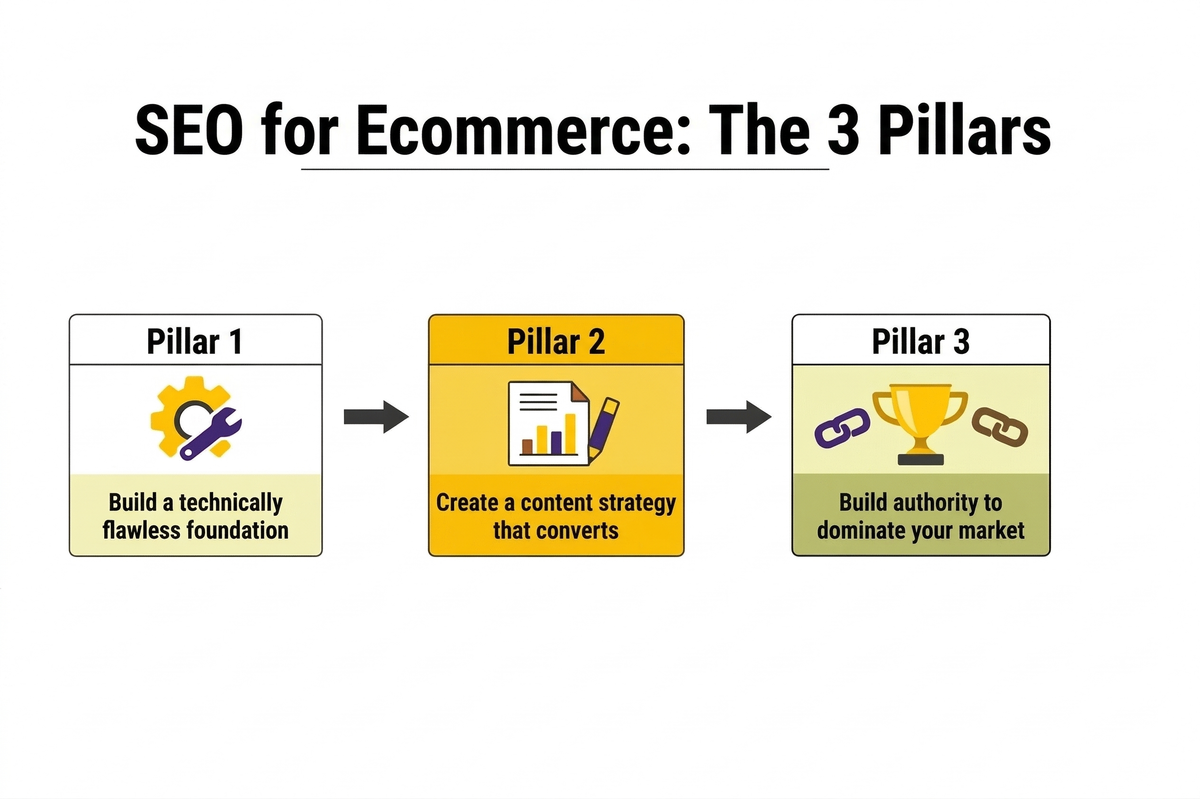
Pillar 1: Build a technically flawless foundation
For businesses, technical SEO is about removing barriers to revenue. It ensures search engines can efficiently crawl (discover and scan pages), interpret, and index (store and organise pages) your website.
Getting this wrong puts a hard ceiling on your growth potential.
Logical site architecture
Thinking about how to structure an ecommerce site for SEO means creating a clear path (e.g., Homepage > Category > Sub-category > Product).
This helps Google understand your most important pages, which is fundamental for ranking.
Managed faceted navigation
The filters on your category pages (size, colour, brand) are a double-edged sword. Handled incorrectly, they can create millions of low-value, duplicate pages that waste Google’s “crawl budget” (its allocated resources for exploring your site) and severely dilute your ranking ability.
This requires a clear strategy using canonical tags, robots.txt disallows, and URL parameter handling.
The right ecommerce platform for SEO
The right platform is the one that gives you control. Whether Shopify, BigCommerce, or Magento, you must be able to edit title tags, meta descriptions, URLs, and alt text, and implement redirects.
A platform that restricts this technical access will always hold your growth back.
Site speed and Core Web Vitals
A slow website loses sales. Google’s Core Web Vitals are metrics that measure a user’s real-world experience, and improving them has a direct, positive impact on conversion rates and search rankings.
Structured data (Schema)
This is code that translates your page’s content into a language search engines can instantly understand.
Implementing Product, Review, and FAQ schema can earn you “rich snippets” in search results - like star ratings, price, and stock availability - which can increase click-through rates (the percentage of people who click after seeing your link).
Pillar 2: Create a content strategy that converts
Your content must do more than simply attract clicks; it must guide a user from discovery to purchase. A commercially-led content strategy maps to every stage of the buyer’s journey, turning visibility into revenue.
Keyword research for buyer intent
A strong ecommerce SEO strategy targets different types of searches -
- Informational (“how to choose a running shoe”)
- Commercial (“best trail running shoes”)
- Transactional (“buy Nike Pegasus size 10”)
Covering all 3 helps you reach customers at every stage of their journey.
Category page optimisation
These are your “money pages”. They are often some of the highest-revenue pages on ecommerce sites because they target broader, high-volume searches.
Add unique, helpful copy (150-300 words) to provide context for users and search engines, helping you rank for the broad, high-volume terms that drive significant traffic.
Product page optimisation
This is where the conversion happens. Write unique, benefit-led product descriptions and never use the manufacturer’s default copy. Sell the outcome.
Instead of “Waterproof to 50m,” write “Wear it swimming, showering, or in a downpour without a second thought.”
Feature high-quality imagery and prominent customer reviews to overcome purchase objections.
Informational content (blog)
A blog isn’t just for show. It’s a strategic tool.
Use it to capture informational searches, build authority in your niche, and link to your key pages, so you pass both traffic and ranking strength where it matters most.
Pillar 3: Build authority to dominate your market
Authority, primarily measured by the quality and quantity of backlinks from other reputable websites, is Google’s core signal of trust. It is what elevates businesses above the competition.
Without it, you are just one of many options.
Authority building (link building/digital PR) focuses on earning trust at scale. This process builds both your brand’s reputation and your website’s ability to rank for the most competitive keywords, creating a powerful and lasting competitive advantage.
The future of ecommerce SEO: An integrated strategy
The way people search is changing. The rise of AI-driven answer engines like ChatGPT, Perplexity, and Google’s AI Overviews is the most significant shift in a generation.
Being prepared is not optional; it is essential for future-proofing your business.
This is where Generative Engine Optimisation (GEO) comes in. GEO is the practice of making your brand, content, and data discoverable, understandable, and citable for AI models.
With 58% of consumers already using AI tools in their shopping journey, if you’re not the source of the answer, you risk becoming invisible.
The good news is that the pillars of strong SEO are also the foundations of good GEO. The next step is to design content architecture that powers AI search visibility and understand processes like LLM retrieval mapping.
Choosing the right partner for ecommerce growth
Ecommerce SEO is a high-stakes discipline where the right strategy can drive millions in revenue. When evaluating SEO services for ecommerce websites, look for a specialist agency with a proven track record of delivering commercial results, not just vanity metrics.
A capable partner should be future-focused with demonstrated expertise in both traditional search and GEO. They must have a clear, cost-focused approach that connects every action back to a measurable return on investment.
If you are comparing your options, our guides to the top SEO agencies in the UK and the leading GEO agencies in the UK can provide a useful starting point.
Conclusion: Turn discoverability into revenue
A successful ecommerce SEO strategy is a powerful, long-term asset built on technical precision, a conversion-focused content strategy, and demonstrable market authority.
For businesses with a growth mindset, integrating these fundamentals with a forward-looking GEO plan is no longer a choice; it is a commercial necessity.
Ready to build a predictable revenue engine with organic search? Book your SEO consultation with Buried. Our conversion-focused approach helps ecommerce brands dominate their market in traditional and AI search.
Work with Buried
Speak to an AI search expert
Tell us your goals and we will build the SEO and GEO strategy to reach them.
Book a call
About the author
Will Tombs
Founder, Buried
Will Tombs is the Founder of Buried. He’s an award-winning growth marketing specialist and expert in SEO and GEO. With over 12 years’ experience in industry, Will has led digital strategy for: Startups that have gone on to be acquired, international enterprise retailers, and his own e-commerce businesses.
From the blog
Related Posts
GEO vs SEO - What's the difference and what should you do about it?
Where the two overlap, where they split, and how to run both.
Will TombsRead →What is link building in SEO & GEO?
Why authoritative mentions still move the needle in both.
Will TombsRead →Top GEO agencies UK
How the leading agencies compare on AI search expertise.
Will TombsRead →