Choosing the right SEO platform is a significant strategic and financial decision. It’s not just a line item in your marketing budget; it’s an investment in your company’s future discoverability, growth, and ultimately, its revenue.
For years, the market has been dominated by 3 major players: Ahrefs, Semrush, and Moz. Each is a powerful suite in its own right.
But the criteria for choosing a platform have changed. The rapid rise of the AI search revolution means that visibility in traditional search engines is no longer the only game in town.
The new priority is Generative Engine Optimisation (GEO), the discipline of making your brand discoverable within AI-driven platforms like ChatGPT, Gemini, Perplexity, and Google’s AI Mode. A tool that excels at yesterday’s SEO may not be equipped for tomorrow’s search landscape.
This guide will cut through the noise. We will compare the “big 3” on the metrics that matter for growth and introduce key alternatives you need to consider to future-proof your strategy. Our goal is to help you maximise discoverability in traditional and AI search, turning visibility into customer conversions.
Why your choice of SEO platform matters for growth
Before comparing features, businesses must understand why this choice matters. The right SEO platform provides the data needed to make critical business decisions, tying marketing activity directly to commercial outcomes.
- Competitive advantage: The right data allows you to analyse competitor strategies, identify high-value keywords they are missing, and find exploitable gaps in the market.
- Revenue growth: By identifying content opportunities and high-intent search terms, you drive qualified traffic that leads to customer conversions.
- Risk reduction: A good tool helps you monitor technical site health and your backlink profile, preventing catastrophic ranking drops that can wipe out leads overnight.
The big 3: Ahrefs vs Semrush vs Moz at a glance
For those short on time, here’s a quick summary.
| Tool | Positioning | Core strengths | AI capabilities | Best for |
|---|---|---|---|---|
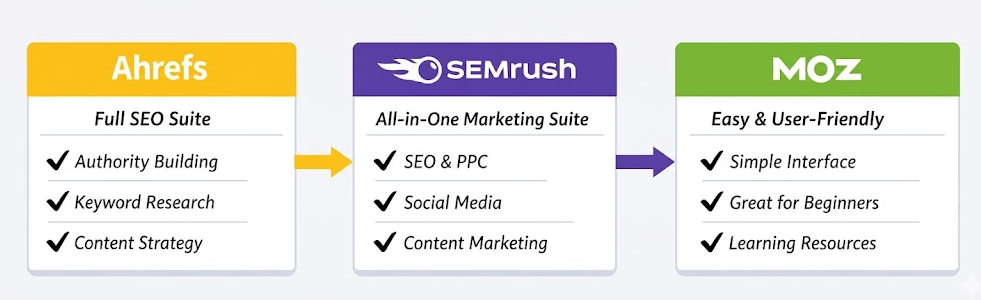
| Ahrefs | Full SEO suite. | Backlink analysis, competitor research, keyword research, content strategy. | AI-assisted content workflows, keyword insights aligned with AI + search behaviour. | SEO-led teams focused on authority building and organic growth. |
| Semrush | All-in-one marketing suite. | SEO, PPC, content marketing, social media management. | Advanced AI tools for content creation, optimisation, and AI search visibility tracking. | In-house teams managing multiple marketing channels. |
| Moz | User-friendly SEO platform. | Simple interface, keyword tracking, site audits, strong learning resources. | AI-assisted insights for easier decision-making. | Beginners, small teams, non-technical users. |
Each tool is excellent, but its strengths serve different business goals.
- Ahrefs: The full SEO suite. It is the go-to tool for ambitious authority-building (link building/digital PR) campaigns, deep competitor analysis, keyword research, and content strategy. Increasingly, it also supports AI-driven content workflows, helping brands uncover content opportunities aligned with how people search via AI and traditional engines.
- Semrush: The comprehensive, all-in-one marketing suite. It’s ideal for teams that manage SEO alongside PPC, social media, and broader content marketing efforts. Semrush has moved fastest into AI, offering tools for content generation, optimisation, and emerging “AI visibility” tracking across search experiences.
- Moz: The highly accessible and user-friendly option. It is excellent for teams newer to SEO or those who value its clear interface and industry-leading educational resources. Moz is evolving with AI-assisted insights that make SEO decisions easier for non-technical users.
Deep dive: When to choose each platform
The “best” platform depends entirely on your primary business objective. Let’s break down the Ahrefs vs Semrush vs Moz debate by looking at their core strengths and use cases.
Ahrefs: The SEO data powerhouse for authority and content strategy
Ahrefs combines best-in-class backlink data with a robust suite of SEO tools. While it remains the industry leader for link intelligence, it is now a complete SEO platform for backlink analysis, competitor research, and data-driven content strategy.
Its strength lies in delivering clean, reliable SEO data that helps teams uncover how competitors rank, where their links come from, and which content drives real traffic.
Key use cases:
- Conducting in-depth competitor analysis across both backlinks and keywords to reverse-engineer rankings.
- Identifying content opportunities through keyword research, traffic potential, and content gap analysis.
- Powering digital PR and link-building campaigns with industry-leading backlink data.
- Performing advanced technical SEO audits using its robust Site Audit tool.
GEO & AI readiness: Ahrefs is a phenomenal tool for influencing GEO, but not for measuring it directly. The authority you build using its data is a critical signal for AI models. However, it was not designed to track brand mentions or citations within generative AI answers.
Semrush: The all-in-one marketing suite
Semrush is built for the marketing team that needs a single view across multiple channels. Its strength is the sheer breadth of its marketing toolkit, covering everything from SEO and PPC to social media and content marketing.
Key use cases:
- Managing integrated campaigns where organic search, paid search, and social media work together.
- Using its extensive keyword and topic research tools to fuel a holistic content strategy.
- Tracking a vast array of keywords across multiple geographies and device types.
GEO & AI readiness: Semrush is adapting to the AI era by integrating features like AI visibility tracking, AI content creation and optimisation, etc. While these are useful, they are often retrofitted for a purpose they weren’t originally designed for. It is a powerful generalist tool, but it lacks the dedicated focus of specialist GEO platforms.
Moz: The accessible tool for education and execution
When comparing Ahrefs vs Moz, the latter’s primary advantage is its user-friendliness. Moz is excellent for empowering teams that are building their SEO expertise, offering clear dashboards and industry-leading educational resources.
Key use cases:
- For in-house teams that are developing their SEO capabilities and need a tool that guides them.
- Tracking core keyword sets and monitoring local search presence with its Moz Local add-on.
- Leveraging its proprietary Domain Authority (DA) metric for top-level reporting, though it should be used as a relative guide, not an absolute truth.
GEO & AI readiness: Historically, Moz has been slower to innovate than its competitors. While it provides solid foundational SEO data that indirectly supports GEO, it falls behind when features like AI visibility tracking are considered.
Beyond the big 3: Are there better alternatives?
The “best” tool might not be one of the big 3. Many other SEO tools are popular among brands and agencies for their emerging features and cost-effectiveness.
Moreover, the focus is quickly shifting towards the future of search. As the market looks for Semrush or Ahrefs alternatives that are purpose-built for AI, a new category of platforms is emerging.
Exploring other popular SEO tools
- SE Ranking: A strong all-in-one SEO platform, especially popular with agencies. Offers rank tracking, site audits, backlink monitoring, and white-label reporting (branded reports you present as yours) - ideal for managing multiple clients efficiently.
- Ubersuggest: A budget-friendly, beginner-focused tool. Covers keyword research, site audits, and content ideas, but with less depth than the big 3. Best for startups or solo marketers.
- Screaming Frog SEO Spider: A specialist technical SEO tool. Known for deep site crawling and identifying issues like broken links, duplicate content, and crawl errors. Not an all-in-one suite, but essential for technical audits.
Specialist tools for an integrated GEO & SEO approach
The primary challenge of GEO is measurement. How do you know if you are being mentioned in the millions of daily AI conversations? The big 3 were not built for this.
A new wave of platforms is designed specifically to provide these insights. These tools attempt to track when brands are cited or referenced in AI-generated answers across platforms like ChatGPT or Perplexity. Key tools include AthenaHQ, PeecAI, Promptwatch, and more.
We’ve spent over 100 hours testing these new platforms. See our complete breakdown in our guide to the best GEO tools.
How to choose the right SEO & GEO tool for your business
Here is a simple, conversion-focused framework for making your decision.
- Define your primary objective: Is your immediate priority fixing technical SEO, launching a new content strategy, authority building, or getting ahead with GEO? Your primary goal should dictate your choice.
- Assess your team’s resources: Consider both budget and in-house expertise. An advanced tool is a wasted investment without the skill to extract actionable insights from it.
- Align with your growth strategy: Choose a tool that provides the data you need to measure success against your most important business KPIs - leads, revenue, and market share - not just marketing vanity metrics.
Maximise your ROI with an expert strategy
A powerful tool is useless without an expert strategy to guide it. As a specialist UK-based organic search agency, we have a practical and data-based approach. We use effective SEO and GEO tools every day to drive measurable growth for our clients.
If you want to move beyond comparing tools and start building a strategy that delivers a clear return on investment, get in touch with the Buried team. Our GEO and SEO services are designed to build a robust, future-proof strategy that delivers measurable returns.
Work with Buried
Speak to an AI search expert
Move beyond comparing tools. Tell us your goals and we will build the SEO and GEO strategy that turns visibility into revenue.
Book a call
About the author
Will Tombs
Founder, Buried
Will Tombs is the Founder of Buried. He’s an award-winning growth marketing specialist and expert in SEO and GEO. With over 12 years’ experience in industry, Will has led digital strategy for: Startups that have gone on to be acquired, international enterprise retailers, and his own e-commerce businesses.
From the blog
Related Posts
Comparing the best GEO tools in 2025
Over 100 hours testing the platforms built to measure AI search visibility.
Will TombsRead →What is SEO content strategy?
How to plan content that ranks in search and gets cited in AI answers.
Will TombsRead →What is link building in SEO & GEO?
Why authoritative mentions still move the needle in both search and AI.
Will TombsRead →